Reviewed · TOURS IN HANOI
Ho Chi Minh Complex & Temple of Literature Tour (half day)
Hanoi’s past comes into focus on this compact walk through the Ho Chi Minh Complex and the Temple of Literature. In about three hours, you move from the site of Vietnam’s 1945 independence declaration to a thousand-year-old center of learning. That is a lot of history in a short morning or afternoon.
I like the choice of two departure times, and I like the small group size of no more than 12 people. An English-speaking local student can also make the political and cultural background easier to grasp. The main caution is that the advertised $5 price does not include the $4 entrance fee, possible transfer costs, food, drinks, or tips.
Key points to know before booking
- Two major Hanoi sights in one outing: You visit the Ho Chi Minh Complex and Temple of Literature during a single three-hour program.
- A useful morning or afternoon choice: Depart at 9:00 AM or 2:00 PM, depending on your booking.
- Small groups keep the guide involved: The maximum group size is 12 people.
- The guide supplies the context: Your English-speaking local student guide explains the political, cultural, and educational meaning of each site.
- The $5 headline price is not the full cost: Add the stated $4 entrance fee per person, plus any transfer costs and personal spending.
- A few named guides have led the tour: Arthur, Linh Chi, Vy, Lily, and Hannah are among the guides associated with past departures.
Why these two sites work well together
This tour links two very different chapters of Vietnamese history. The Ho Chi Minh Complex focuses on the modern nation and the figure who led Vietnam through its struggle for independence. The Temple of Literature takes you much farther back, to the Ly and Tran dynasties and Vietnam’s traditional system of education.
That contrast gives the outing a clear shape. You begin with state history, national identity, and the life of Ho Chi Minh. You finish among courtyards, gates, and quiet architectural details tied to Confucian learning. If you visit both places on your own, you may see the buildings but miss the connection. A guide helps explain why each site matters.
The tour is also short enough to fit neatly into a busy Hanoi schedule. You can place it before a free afternoon, after breakfast, or alongside other plans in the Old Quarter and central Hanoi. Just remember that the 3-hour estimate does not mean every stop receives equal time. The Temple of Literature gets about an hour, while some parts of the Ho Chi Minh Complex are brief viewing stops.
More days out you can book in Hanoi:
- Hanoi Jeep Tour: Food, Culture and Fun by Vietnam Army Jeep
★ 5.0 · 15,222 reviews - Full-Day Ninh Binh Highlights Tour from Hanoi
★ 5.0 · 7,761 reviews - Hanoi: Ha Long Bay Day Cruise – Swimming, Meal, Kayaking
★ 4.7 · 7,415 reviews
Meeting at 19 P. Ngọc Hà
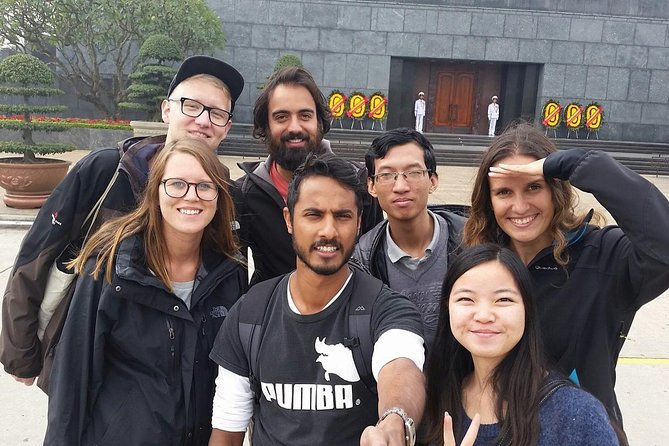
The meeting point is 19 P. Ngọc Hà, Đội Cấn, Ba Đình, Hanoi. The activity begins and ends at this meeting point, so you should plan your route carefully rather than assume hotel pickup is included.
The tour details say the guide will welcome you at your hotel and take you to the complex, but the included services list only an English-speaking local student and notes that transfer fees, if any, are not included. For that reason, confirm the exact pickup arrangement and any transport charge before setting out. The meeting point is near public transportation, which gives you another practical way to reach the start.
Your guide may be one of the local students who have led this route before, including Arthur, Linh Chi, Vy, Lily, or Hannah. The strongest guide comments focus on clear English, historical explanations, friendliness, and the ability to adjust to the group’s interests. One guide, Linh Chi, was specifically praised for responding to personal preferences, while Lily was noted for adding further Hanoi suggestions.
Ho Chi Minh Mausoleum and Ba Dinh Square
The first major stop is the Ho Chi Minh Mausoleum, part of a large complex built to express national pride. You can start at 9:00 AM or 2:00 PM, and the mausoleum portion is scheduled for about 30 minutes.
Ba Dinh Square gives the site its political weight. This is where Ho Chi Minh read Vietnam’s Declaration of Independence on September 2, 1945. Your guide can help you understand why the square is more than an open public space. It is tied directly to the founding story of modern Vietnam.
The itinerary allows about 10 minutes at Ba Dinh Square. That is enough to take in the setting and hear the key facts, but not enough for an extended study of every detail. If you want a long, slow visit to the complex, this tour may feel brisk. If you want an efficient introduction with the important background explained, the pace is sensible.
The mausoleum itself is a solemn place, and the tour treats it as part of a formal national complex rather than as a casual sightseeing stop. Keep your expectations practical. You are visiting a symbolic site with rules and a controlled atmosphere, not a relaxed museum where you can wander at your own pace.
The stilt house and a simpler side of Ho Chi Minh
The next stop is Ho Chi Minh’s Stilt House, scheduled for about 10 minutes. The tour explains that Ho Chi Minh refused to live in the Presidential Palace and instead used a more modest house nearby.
He lived in the stilt house from 1958 until his death. That detail helps explain why the house has such a strong place in the national story. The contrast between the grand presidential setting and a simpler residence is central to the way Ho Chi Minh is remembered.
Ten minutes is a short visit, but it can be enough to understand the main point. Your guide can supply the personal and political context that a quick look at the structure would not provide. If you are interested in architecture or domestic details, you may wish the schedule allowed longer here.
Same base, a completely different day:
- Hanoi: Water Puppet Show Tickets
★ 4.6 · 7,029 reviews - Hanoi Motorbike Tour: Food, Culture and Fun by Vintage Motorbike
★ 5.0 · 6,699 reviews - Hanoi: Guided Food Tour with Train Street Visit
★ 4.9 · 6,239 reviews - Hanoi Cooking Class: Culture, Local Market & Meaning CSR Impact
★ 5.0 · 5,147 reviews
One Pillar Pagoda and the Ly Dynasty
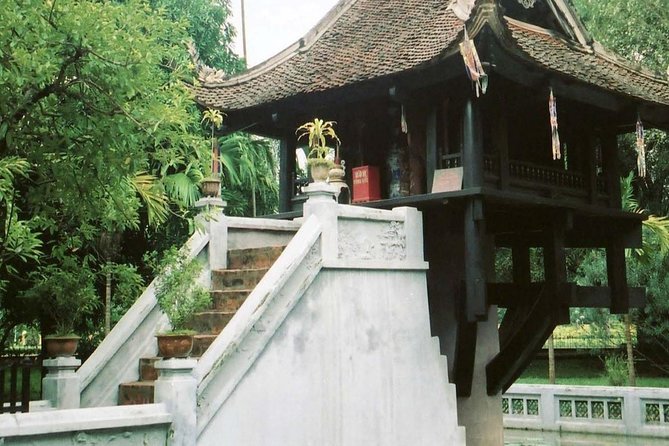
The One Pillar Pagoda is one of the most recognizable structures in the complex. The pagoda dates to 1049, during the Ly Dynasty, and the tour introduces the legend connected with its construction.
This stop is scheduled for about 10 minutes. That works well for a concise explanation of the pagoda’s age, design, and story, followed by time to view it. It is a small site, so the brief timing is less restrictive than it would be at a large museum.
The pagoda also helps prepare you for the Temple of Literature. Both places reach back to earlier dynasties, giving the tour a historical range that goes far beyond the 20th-century story of Ho Chi Minh.
Ho Chi Minh Museum: the longest stop in the complex
The Ho Chi Minh Museum receives about 20 minutes. The building is shaped like a white lotus and rises nearly 20 meters over three floors. Its displays include more than 2,000 documents and objects related to Ho Chi Minh and Vietnam’s political history.
Twenty minutes is enough for an introduction, especially with a guide selecting the main points. It is not enough for a careful look at thousands of documents. If museums are your main interest, you should think of this as an orientation rather than a full museum visit.
This is one place where the guide’s skill matters most. The material can be political, symbolic, and unfamiliar if you do not know the background. A strong explanation can make the displays easier to place within Vietnam’s story. The guide accounts consistently emphasize that this context is the main reason to take the tour instead of simply passing through the building alone.
Temple of Literature and Vietnam’s first university
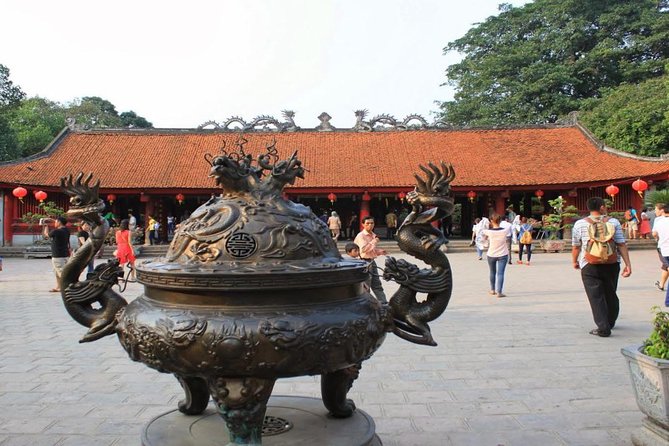
The final major stop is the Temple of Literature and National University, with about one hour set aside. This is the most generous block of time on the schedule, and rightly so. The complex is often considered one of Hanoi’s most picturesque attractions, but its importance goes beyond its courtyards and traditional design.
The Temple of Literature was Vietnam’s first university and also a place of worship for Confucius. It takes you back to the Ly and Tran dynasties, when education, scholarship, and Confucian values shaped public life.
An hour lets you move through the site without reducing it to a quick photo stop. Your guide can explain why the temple functioned as an educational center and help you read the site as more than a collection of old buildings. This is also where the tour’s shift from modern political history to older cultural history becomes clearest.
I would pay close attention here if you have limited time in Hanoi. The Temple of Literature gives you a different view of Vietnam from the Ho Chi Minh Complex. Instead of focusing on independence and leadership, it shows how education and tradition helped shape the country.
What the English-speaking student guide adds
The tour includes an English-speaking local student rather than a guide described as a senior historian or specialist. That distinction matters. You are booking a friendly, educational introduction, not a private academic seminar.
The best guide experiences connected with this tour have included clear explanations, good English, patience, and a willingness to answer questions. Arthur helped explain the importance of the places visited. Linh Chi was attentive to individual interests. Vy made the route easy and informative, while Lily combined historical explanation with additional Hanoi suggestions. Hannah was described as helpful and personable.
Those names do not guarantee who will lead your departure, but they show the sort of guiding style you can expect when the match is good. You should ask questions as you go. A small group of up to 12 makes it easier to speak with the guide than on a large coach outing.
The size also affects the pace. A group of 12 is not truly private, but it is small enough for a more personal feel. The tour description calls it a personalized small-group experience, and that is a fair expectation as long as you understand that other people will share the route.
The $5 price and the real value
At $5 per person, the advertised tour fee is unusually low for a guided three-hour visit to several major Hanoi sights. The value comes from having the route organized and having someone explain the political and cultural meaning of the sites.
You must add the stated $4 entrance fee per person. Transfer fees, if any, are also extra, along with food, drinks, tips, and personal expenses. That means the final cost is higher than the headline price, but it can still be good value if you want historical context without paying for a private guide.
Group discounts are available, and mobile tickets are supported. Confirmation is received at booking. The tour is also near public transportation, which may help keep your total cost down if you arrange your own way to the meeting point.
The price is less attractive if you only want to photograph the main buildings and leave quickly. Several stops are short, and admission is not included. It becomes a better buy for you if you value explanations, an orderly route, and the chance to ask questions.
Timing, weather, and practical limits
The tour lasts about three hours and offers a 9:00 AM or 2:00 PM start. The morning option may suit you if you want to continue sightseeing afterward. The afternoon departure may fit better if you prefer a slower start to the day.
The experience requires good weather. If poor weather causes cancellation, you are offered a different date or a full refund. Under normal circumstances, the booking is non-refundable and cannot be changed for any reason, so check your schedule before paying.
Most people can participate, and the tour is near public transportation. The published information does not give detailed accessibility instructions for every stop, so you should contact the provider if you need specific mobility information.
The route ends back at the meeting point. That is convenient if you plan to continue exploring Ba Dinh, but it means you should not treat the tour as a one-way transfer to another part of Hanoi.
Who should book this Hanoi tour?
I would choose this outing if you are visiting Hanoi for the first time and want the main facts explained without spending a full day on a single museum or monument. It also suits you if you are interested in modern Vietnamese politics, national identity, Confucian education, or the transition from older dynasties to the modern state.
It is a good match for solo visitors and couples who want a small group rather than a large bus. Families may also find the short stops manageable, though the political material and museum visit may be more interesting to older children.
You may want to skip it if you prefer complete independence, long visits at each site, or a guide with a formal specialist background. You should also think twice if the fixed meeting point and extra entrance fee do not fit your plans.
Should you book it?
Book this tour if you want an inexpensive, structured introduction to two of Hanoi’s most important historical areas. The strongest reason to go is the guide. Names such as Arthur, Linh Chi, Vy, Lily, and Hannah are linked with clear and friendly departures, and the route benefits greatly from someone who can explain what you are seeing.
Go in with realistic expectations. The $5 fee is not all-inclusive, several stops are short, and the activity is non-refundable in ordinary circumstances. If you accept those limits, the combination of Ba Dinh Square, Ho Chi Minh’s residences, the One Pillar Pagoda, the museum, and the Temple of Literature makes this a useful three-hour introduction to Hanoi’s past.
FAQ
How long does the tour last?
The tour lasts approximately three hours.
What time does the tour start?
You can choose a 9:00 AM or 2:00 PM start, depending on your booking.
Where does the tour begin?
It begins at 19 P. Ngọc Hà, Đội Cấn, Ba Đình, Hanoi 11113, Vietnam.
Where does the tour end?
The activity ends back at the meeting point.
What sights are included?
The route includes Ho Chi Minh’s Mausoleum, Ba Dinh Square, Ho Chi Minh’s Stilt House, One Pillar Pagoda, Ho Chi Minh Museum, and the Temple of Literature and National University.
Is the entrance fee included?
No. The stated entrance fee is $4 per person.
What is included in the tour?
An English-speaking local student guide is included.
Are transfers included?
Transfer fees, if any, are not included. The activity is near public transportation.
How many people can join the group?
The group has a maximum of 12 travelers.
Can I cancel or change the booking?
The experience is non-refundable and cannot be changed for any reason. If poor weather causes the operator to cancel, you are offered a different date or a full refund.
Newly reviewed in Hanoi
- Private Full-Day Tour to Halong Bay from Hanoi★ 5.0 · 44 reviews
- Private Evening Walking Tour – Cyclo & Water Puppet Show in Hanoi Old Quarter★ 5.0 · 19 reviews
- Ba Vi National Park Private Tour: Sightseeings & Jungle Hikking★ 4.5 · 26 reviews
- Full-Day Hanoi City Tour with Hidden Local Life Experience★ 5.0 · 27 reviews
- Hanoi Epic tour 6D5N Hanoi – Halong Bay – Ninh Binh – Sapa★ 5.0 · 51 reviews
- Private transfers Hanoi <=> Puluong 1 Way (Free Hotel Pickup)★ 5.0 · 20 reviews
- Hanoi Airport Pick-up (Private Ride From Hanoi Airport to Hotels)★ 4.5 · 253 reviews
- Noi Bai Airport transfer to Hotel or Vice versa★ 5.0 · 144 reviews
Tours in Hanoi, compared.

Hanoi Jeep Tour: Food, Culture and Fun by Vietnam Army Jeep
Read our review →
Full-Day Ninh Binh Highlights Tour from Hanoi
Read our review →
Ha Long Bay Day Cruise – Swimming, Meal, Kayaking
Read our review →

Hanoi Motorbike Tour: Food, Culture and Fun by Vintage Motorbike
Read our review →

Hanoi Cooking Class: Culture, Local Market & Meaning CSR Impact
Read our review →