

Reviewed · TOURS IN HUE
Hue City Full-Day Tour
Hue’s story begins on the Perfume River, and this tour starts in the right place: on the water, heading toward Thien Mu Pagoda before moving into the royal heart of the city. From there, you’ll enter the Imperial Citadel, see two very different royal tombs, and finish with visits to conical-hat and incense-making villages.
I like the mix of major monuments and local craft. You get the Flag Tower, Noon Gate, Thai Hoa Palace, the Forbidden Purple City, and the 9 Dynastic Urns, but you also see how traditional hats and incense are made. I also like that lunch, admission fees, an air-conditioned minivan, and a dragon boat ride are included in the $73 price.
The main drawback is the pace. This is a full day in Hue’s heat, with plenty of walking and several large sites. The boat ride can also be interrupted by persistent selling aboard the vessel, so keep your attention on the river and be ready to decline politely.
Key points to know before booking
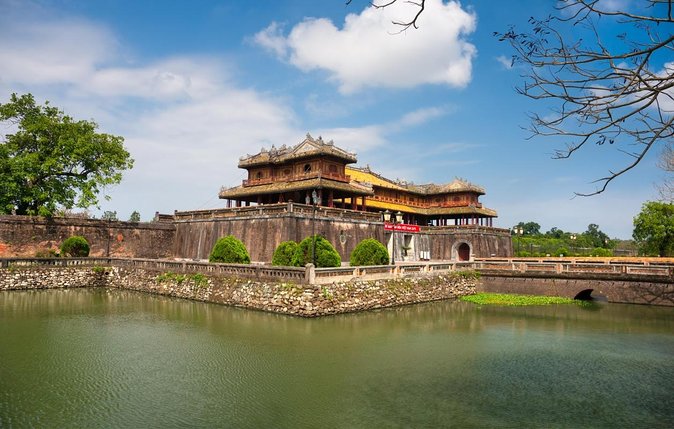
- Perfume River opening: Start by boat and reach Thien Mu Pagoda from the water before touring Hue by road.
- Royal Vietnam in one day: Visit the Imperial Citadel, Khai Dinh’s Tomb, and Tu Duc’s Tomb, each offering a different view of Nguyen Dynasty rule.
- Useful inclusions: Lunch, entrance fees, mineral water, air-conditioned transport, an English-speaking guide, and the dragon boat are covered.
- Strong guiding: Guides such as Hong and Loc are praised for clear explanations, local insight, and keeping the day moving on time.
- Craft villages included: See conical hats and incense sticks being made, adding a practical local stop to the palace and tomb visits.
- Plan for walking: Comfortable shoes are essential, and the tour is not suitable for people with mobility impairments.
Why Hue works best when you connect the river, citadel, and tombs
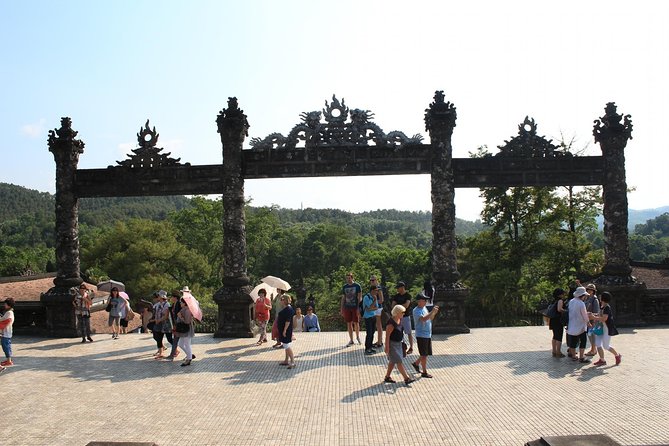
Hue was Vietnam’s imperial capital from 1802 to 1945, when the Nguyen Dynasty ruled from the city. Its monuments are spread along and around the Perfume River, so a tour that combines boat travel with a minivan saves you from trying to piece the city together on your own.
I like the way this itinerary explains royal Hue through places rather than a long lecture. The citadel shows the machinery of government. The tombs show how individual emperors wanted to be remembered. Thien Mu Pagoda brings in the religious side of the city, while the craft villages show that Hue is more than a collection of old walls.
You will spend a lot of the day outside. Hue can be hot, and the schedule includes several major sites with walking between courtyards, gates, halls, and tomb structures. Bring comfortable shoes, drink the supplied mineral water, and use the breaks wisely.
The tour is described as private, but the exact group size is not provided. Pickup is available only from hotels within Hue city, so you should confirm that your accommodation falls inside the pickup area before booking.
A few more ways to spend a day in Hue Vietnam
- Hue City Tour Full Day – Group Tour
★ 4.7 · 518 reviews - From Da Nang/Hoian/Hue: Hue Imperial City Full-Day Tour
★ 4.8 · 295 reviews - Hue City Tour Full day – Small group tour
★ 4.7 · 137 reviews
Cruising the Perfume River to Thien Mu Pagoda
The dragon boat ride gives you a calm opening to a busy day. From the river, you begin to understand why Hue’s royal and religious buildings were placed along this waterway. The ride is also a practical way to reach Thien Mu Pagoda, one of the city’s best-known religious sites.
Thien Mu Pagoda is often called the symbol of Hue. The stop adds a quieter, spiritual note before the imperial monuments take over. You can expect your guide to explain the pagoda’s place in Hue’s religious life and connect it to the larger story of the city.
The river portion is not a luxury cruise. It is transportation and sightseeing in one, with an atmosphere that depends partly on conditions aboard the boat. A sales person may try to sell items during the ride, and that can distract from the view. If you want to enjoy the river, sit where you can look outside, keep your focus on the scenery, and politely refuse purchases if you are not interested.
That small annoyance is worth knowing in advance because the cruise is one of the tour’s headline features. It is still a useful start, but you should not book this expecting a private, silent boat journey.
Entering the Imperial Citadel through the Noon Gate
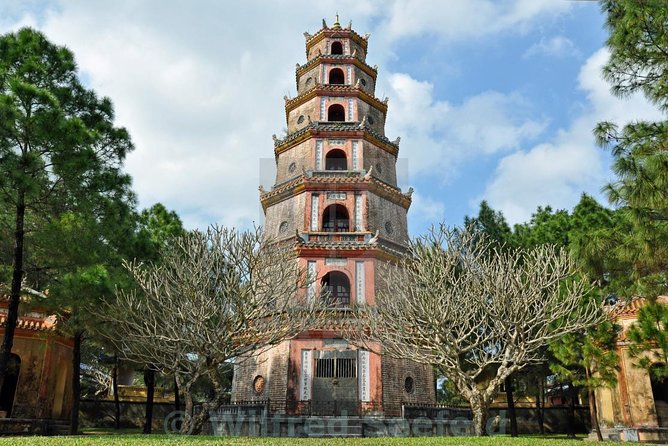
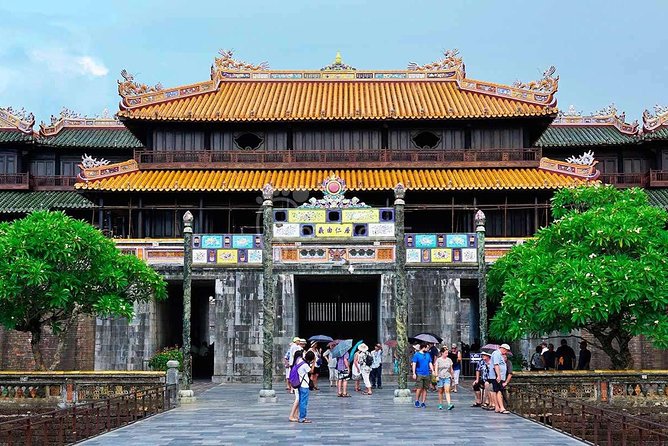
After the river section, the tour shifts to Hue’s political center: the Imperial Citadel. This was the seat of the Nguyen Dynasty from 1802 until 1945, and the scale of the complex helps explain how much power was concentrated here.
Your route includes several important landmarks:
- Flag Tower: A prominent marker near the citadel entrance and an easy way to grasp the scale of the defensive complex.
- Noon Gate: The formal gateway into the imperial grounds, with a strong sense of ceremony and control.
- 9 Dynastic Urns: Large ceremonial urns linked to the Nguyen rulers.
- 9 Holy Cannons: Historic defensive pieces that add a military layer to the royal story.
- Thai Hoa Palace: One of the key ceremonial buildings in the citadel.
- Forbidden Purple City: The innermost royal area, associated with the private world of the emperor and court.
The value of a guide is especially clear here. Without context, the citadel can feel like a sequence of gates, courtyards, and restored buildings. With an English-speaking guide, you can connect each space to court ritual, royal family life, and the structure of Nguyen rule.
The site is large, and not every part may feel equally complete. You should expect open areas and considerable walking rather than a single polished palace visit. Still, this is the essential Hue stop. If you have only one day in the city, the citadel gives you the clearest picture of Hue as an imperial capital.
A previous guide named Loc was praised for being lively, answering many questions, and keeping the history approachable. Hong was also singled out for engaging explanations. Your assigned guide may differ, but the tour is designed around live English commentary rather than a self-guided visit.
Lunch before two very different royal tombs
A lunch break comes after the citadel. The meal is included, which helps the $73 price feel more manageable, especially since admission fees, transport, and bottled water are also covered.
The supplied information does not specify the restaurant, menu, or length of the break. I would treat lunch as a practical pause rather than a food-focused part of the experience. It gives you time to sit down before the afternoon tomb visits, which matter because the day involves a lot of walking and sightseeing in the open air.
The order also makes sense. The morning focuses on the city center and royal administration. After lunch, you move outward to the places where individual emperors shaped their own memorial spaces.
Same base, a completely different day:
- Hue Customizable Tour with Imperial Citadel & Forbidden City
★ 4.9 · 937 reviews - Hue :Exploring Royal City with Multi Options and Dragon Boat
★ 5.0 · 675 reviews - From Hue: DMZ Tour with Vinh Moc Tunnels and Khe Sanh Base
★ 4.9 · 503 reviews - Hue: Private Car to Hoi An via Fabulous Stops
★ 5.0 · 371 reviews
Khai Dinh’s Tomb and the meeting of East and West
Khai Dinh’s Tomb offers a different visual mood from the Imperial Citadel. The architecture blends Western and Eastern influences, making the site useful for understanding how royal design changed during the later Nguyen period.
Your guide can help you read the building as more than an elaborate burial place. The tomb reflects the emperor’s taste and the period’s contact with foreign ideas. Look for the contrast between traditional Vietnamese imperial forms and imported architectural touches.
This stop is best for travelers who enjoy detail. You may find the decoration more visually dense than the citadel, with stairs, terraces, and formal structures shaping the visit. It is not simply a quiet garden. The route can feel demanding in the heat, so take your time where the schedule allows.
Khai Dinh’s Tomb also prepares you for the next stop. The two tombs are not interchangeable. Seeing both lets you compare the choices made by different rulers rather than forming an impression of royal tombs from a single monument.
Tu Duc’s Tomb and the emperor’s philosophy of place
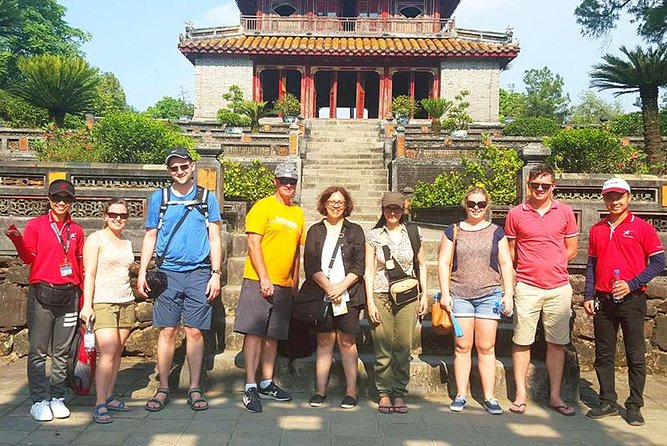
Tu Duc’s Tomb is presented as a place of majesty and symmetry. It gives the tour a more measured architectural experience after the detailed style of Khai Dinh’s complex.
The guide’s explanation of royal philosophy is important here, especially the role of geomancy. The location and arrangement of royal sites were tied to ideas about balance, natural forces, protection, and the relationship between buildings and their surroundings. This helps explain why the tombs are designed as carefully organized ensembles instead of simple graves.
You will also hear about how this philosophy affected royal life. That is one of the more valuable parts of the day because it moves beyond dates and names. You begin to see how an emperor’s final resting place could express power, personal beliefs, and ideas about order.
The two tomb visits can become tiring if you rush them. I would pay attention to the guide’s comparisons, since the contrast between Khai Dinh and Tu Duc is more useful than treating each stop as an isolated photo opportunity.
Conical hats and incense in the villages
The final part of the route visits a conical-hat village and an incense stick-making village. These stops add everyday craft to a day otherwise dominated by palaces, tombs, and religious monuments.
The conical hat is one of Vietnam’s most recognizable traditional objects, but seeing it made gives you a better sense of the work behind it. The incense village offers a similar shift in focus. You can watch a traditional product being prepared and see a small-scale craft setting rather than another royal structure.
These visits also give you a chance to buy souvenirs. You are not required to purchase anything, but the stops can feel more useful if you are interested in how local goods are made. The craft visits are brief compared with the major monuments, so think of them as a final layer to the day rather than the main reason to book.
I like this ending because it keeps Hue from becoming only a history lesson. The city’s royal past matters, but so do the skills and products that remain part of local life.
What the $73 price really covers

At $73 per person, this is not the cheapest way to see Hue, but the package includes several costs that add up quickly. You receive an air-conditioned minivan, dragon boat transportation, an English-speaking guide, lunch, entrance fees, and mineral water.
The strongest value comes from combining all the major pieces in one day. You do not need to arrange a separate boat ride, pay each monument entrance fee as you go, or find transport between the citadel, tombs, and villages. A guide also matters in Hue because the sites are more meaningful when you understand the Nguyen court and the ideas behind royal architecture.
The value is weaker if you prefer to move slowly or spend a long time at one monument. This is a packed day, and the exact starting time depends on availability. You should check the schedule before booking and make sure a full day of organized sightseeing fits your travel style.
Free cancellation up to 24 hours before the start gives you some flexibility, and you can reserve without paying immediately. Insurance is not included, so you need to arrange that separately if you want coverage.
Who should book this Hue day trip?
I would choose this tour if you have one full day in Hue and want the main historic sights handled in a single route. It suits you if you value explanations, included admission fees, and the ease of hotel pickup within Hue city.
It is also a good fit if you want more than monuments. The river cruise, Thien Mu Pagoda, royal tombs, and craft villages create a broader picture of Hue than a citadel-only visit.
You may want another plan if you have mobility limitations, dislike long days outdoors, or prefer independent sightseeing. Large bags and luggage are not allowed, and comfortable shoes are a must. The tour is not suitable for people with mobility impairments.
The quality of the day depends partly on your guide. Hong and Loc are examples of guides who brought energy, local perspective, and clear answers to the route. If you are assigned a guide with the same style, the history should feel much easier to follow than it would from plaques alone.
Should you book the Hue City Full-Day Tour?
Book it if you want a practical first look at Hue’s imperial core and prefer one organized day over several separate arrangements. The route covers the sites I would prioritize: the Perfume River, Thien Mu Pagoda, Imperial Citadel, Khai Dinh’s Tomb, Tu Duc’s Tomb, and two traditional craft villages.
The $73 cost is fair because transport, lunch, admission, and guiding are included. Just set realistic expectations: the day is full, walking is unavoidable, the boat may include sales pressure, and the exact lunch details are not specified.
For a first visit with limited time, I would book it and wear light, comfortable shoes. For a slower return visit, I would split the citadel and tombs across separate days.
FAQ
How long is the Hue City Full-Day Tour?
The experience lasts one full day. Starting times vary, so you need to check availability for the date you want.
What language is the tour guide?
The tour includes a live English-speaking guide.
Does hotel pickup come with the tour?
Yes. Pickup is available from hotels within Hue city only.
What is included in the price?
The price includes an air-conditioned minivan, dragon boat trip, English-speaking guide, bottled mineral water, lunch, and entrance fees.
Which major sites are included?
The itinerary includes Thien Mu Pagoda, the Imperial Citadel, Khai Dinh’s Tomb, and Tu Duc’s Tomb. It also visits a conical-hat village and an incense stick-making village.
Is the tour suitable for people with mobility impairments?
No. The tour is not suitable for people with mobility impairments, and comfortable shoes are recommended.
Can I cancel the booking?
Yes. You can cancel up to 24 hours in advance for a full refund. You can also reserve now and pay later.
Newly reviewed in Hue Vietnam
- Phong Nha National Park: Paradise Cave Half-Day Tour★ 5.0 · 23 reviews
- Official Hue: Dragon Boat, Imperial Citadel, & Market tour★ 4.7 · 32 reviews
- Hue to Hoi An/Da Nang: Private Scenic Motorbike Tour★ 4.9 · 63 reviews
- Hue: Royal Tombs Private Tour with 3 Best Tombs & Pagoda★ 4.9 · 213 reviews
- Hue to Hoi An by bus: Hai Van Pass, Lang Co, Marble mountain★ 4.6 · 27 reviews
- Hue: Private Transfer to/from Hoi An via Sightseeing Stops★ 4.9 · 111 reviews
- Hue: Royal Tombs & Pagoda Private Tour By Dragon Boat & Car★ 4.9 · 257 reviews
- Hue Private Tour with Local Guide – Customize Your Itinerary★ 4.8 · 28 reviews
Tours in Hue, compared.
Hue to Hoi An ( Hoi An to Hue) Top Gear with Lefamily Riders Tours ( 1 way)
Read our review →
Easy Rider private tour via Hai Van pass from Hue – Da Nang – Hoi An (1Way|Loop)
Read our review →
Hue Customizable Tour with Imperial Citadel & Forbidden City
Read our review →
Easy Rider From Hue Da Nang Hoi An Via Hai Van Pass With Mister T
Read our review →
Hue to Dn/Hoi An: Hai Van Pass, beaches & Mt Monkey or vice versa
Read our review →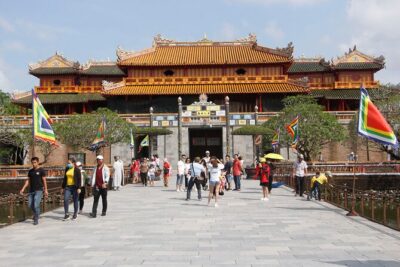
Imperial City Walk, Motorbike Tour & Private Car Options
Read our review →
Exploring Royal City with Multi Options and Dragon Boat
Read our review →
Hue city Deluxe Group Tour (Daily Tour-12 pax max)
Read our review →Browse the lists this tour appears in