Reviewed · TOURS IN HANOI
Hanoi: Centuries of Highlights in 1 Hour by Open-Top Bus
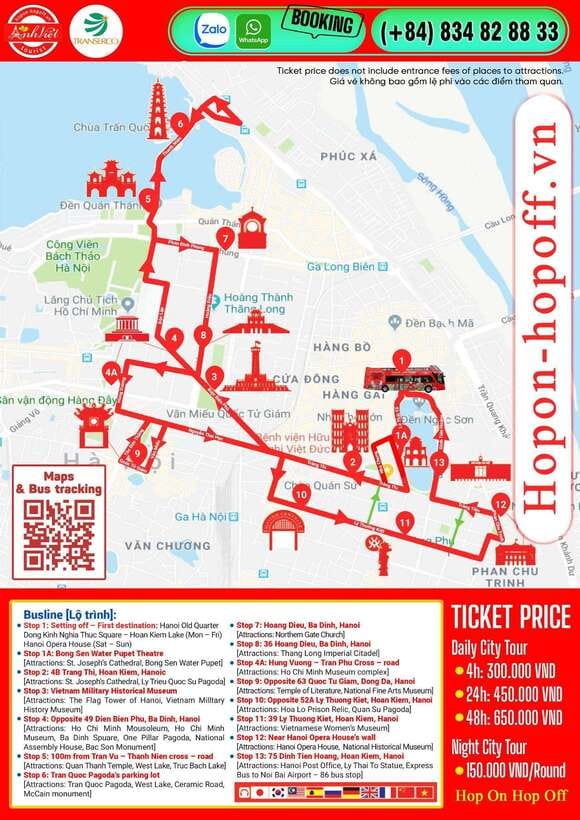
Hanoi packs more than a thousand years of history into a surprisingly small central area, and this one-hour open-top bus loop gives you a quick look at the main landmarks without asking you to master the city’s traffic first. You’ll pass from Hoan Kiem Lake and the Old Quarter toward Ba Dinh Square, the Ho Chi Minh Complex, the Temple of Literature, and the French-colonial center.
I like the low price of $7 and the broad route. You see more than 20 important sights in a single ride, and the upper deck gives you a better view of buildings than you’ll get from a regular car or taxi. I also like the useful extras: free water, a conical hat, rain protection, Wi-Fi, and commentary in eight languages.
The main catch is that this is a non-stop circuit, not a hop-on, hop-off ticket. The audio guide can also crackle, fall out of sync with the sights, or be unavailable, so treat the commentary as a bonus rather than the sole reason to book.
Key points at a glance

- One hour, more than 20 sights: This is a fast orientation ride, not a visit inside the monuments.
- A strong first look at Hanoi: The route links Hoan Kiem Lake, the Old Quarter, Ba Dinh Square, the Temple of Literature, and the Opera House.
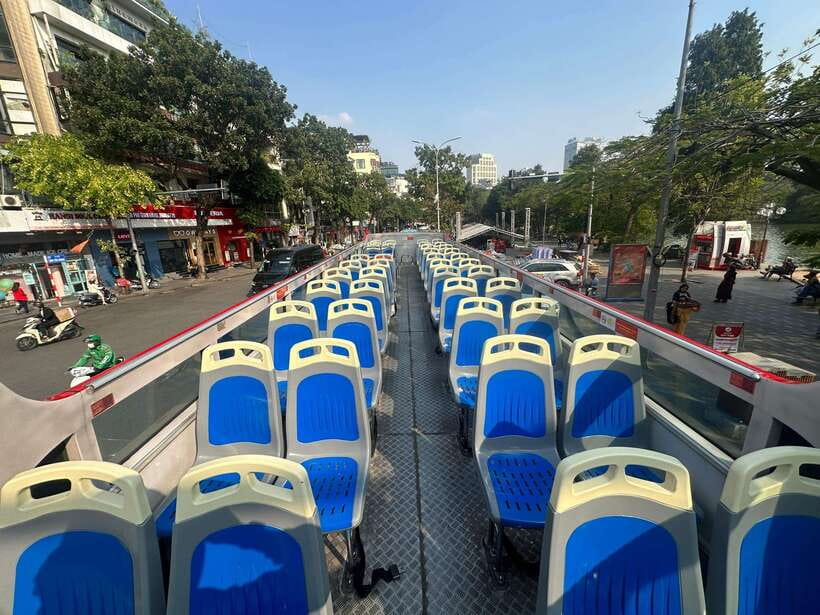
- Open-top views: The upper deck helps you see rooftops, towers, temples, and colonial buildings above Hanoi’s busy streets.
- Eight audio languages: English, French, German, Spanish, Russian, Japanese, Korean, and Vietnamese are offered.
- Non-stop means careful planning: You can board once, but getting off means you cannot reboard.
- Meeting point details matter: The bus uses Dong Kinh Nghia Thuc Square until Friday evening, then Hanoi Opera House on Friday night and weekends.
Why this short Hanoi ride works
At $7, this tour is best understood as a moving introduction to Hanoi. You are not paying for a guided walk, entry to monuments, or a full historical lesson. You are paying for a seat, a fixed route, and a quick look at the city’s main landmarks.
That can be good value on your first day. Hanoi’s center is easy to reach on foot, but its sights are scattered across several neighborhoods. This ride lets you see how Hoan Kiem, the Old Quarter, Ba Dinh, and the French quarter fit together before you decide where to spend more time.
I would especially consider it if you have only a short stay, a long layover, or limited energy for walking. It also works well as a morning orientation before returning to individual sights later. The entire loop takes about an hour, though traffic can make the timing less exact.
The bus operates from 8:30 am until 9:30 pm Monday through Thursday, and from 8:30 am until 8:00 pm Friday through Sunday. Service is scheduled about every 30 minutes. Traffic, road closures, public holidays, and weather can change the route or reduce the frequency, so do not build a tight connection around the advertised departure.
A few more ways to spend a day in Hanoi
- 1 Hour Saigon River Tour in Ho Chi Minh
★ 4.5 · 418 reviews
Starting at Hoan Kiem Lake and the Old Quarter
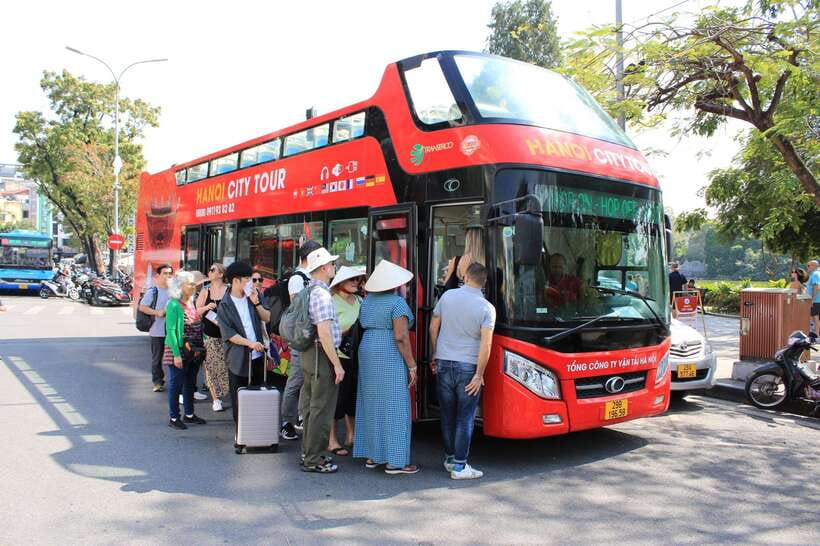
On Monday through Friday until 7:00 pm, the meeting point is at Dong Kinh Nghia Thuc Square, at 7 Dinh Tien Hoang. Look for the red double-decker Hanoi City Tour ticket booth.
Allow extra time at this point. You need to show your paper or mobile ticket when boarding, and one practical note says you may need to exchange the barcode or ticket at the counter near the lake before walking roughly 300 meters to the bus. The exact boarding process may not feel as direct as the booking description suggests.
The ride begins in the area around Hoan Kiem Lake, one of Hanoi’s most useful reference points. The lake sits beside the Old Quarter and is surrounded by streets, cafés, shops, and public buildings. From the bus, you get the location and atmosphere rather than a close look at the small details.
Saint Joseph Cathedral is another early landmark. Its dark stone facade and twin towers reflect Hanoi’s French colonial period, while the surrounding streets show how old religious buildings share space with modern city life. You will see the cathedral from the bus, but you will not stop to enter it.
The Old Quarter is one of the best parts of the ride simply because the bus gives you a wider view of a dense district. Narrow streets, low buildings, shopfronts, and constant traffic make Hanoi feel energetic at street level. From the upper deck, you can look over the roofs and follow the changing shape of the neighborhood.
Do not expect a quiet, slow pass through the Old Quarter. Hanoi traffic can be loud and crowded, and the bus may move slowly. That is part of the setting, but it also makes the audio harder to hear at times.
From the Flag Tower to Ba Dinh Square
The route then heads toward Hanoi Flag Tower and the Ba Dinh area. The flag tower is one of the city’s most recognizable military landmarks, with a red flag rising above the brick structure. A bus seat lets you frame the tower with fewer street-level obstructions than you might have on foot.
Ba Dinh Square is the political and ceremonial center of modern Hanoi. The broad open space leads to the Ho Chi Minh Mausoleum and the surrounding Ho Chi Minh Complex. The scale changes quickly here. After the narrow Old Quarter, you see wide roads, formal grounds, and government buildings.
The bus provides a panorama of this area, but it does not replace a visit. You will not enter the mausoleum or tour the complex, and the ride gives you only a passing view. If the Ho Chi Minh site matters to you, use this section to get oriented, then return on foot with more time.
The change from crowded streets to formal public space is one of the more useful parts of the route. In one short journey, you see two very different sides of Hanoi: the commercial center and the ceremonial heart of the capital.
Temples, churches, and the western side of the route

Quan Thanh Temple and Tran Quoc Pagoda bring religious landmarks into the circuit. Quan Thanh Temple is linked with Taoist tradition, while Tran Quoc Pagoda sits beside West Lake and is among Hanoi’s best-known Buddhist sites.
You should think of this section as a preview. The bus gives you a sense of location and lets you see the buildings from above, but you will not have time to study statues, incense burners, gates, or gardens. If you want a calmer cultural stop, return separately to the site that interests you most.
Cua Bac Church adds another architectural contrast. Like Saint Joseph Cathedral, it points to Hanoi’s Catholic and colonial past, but the two churches appear in different parts of the city. Seeing them alongside temples and pagodas helps you understand how varied Hanoi’s religious architecture is.
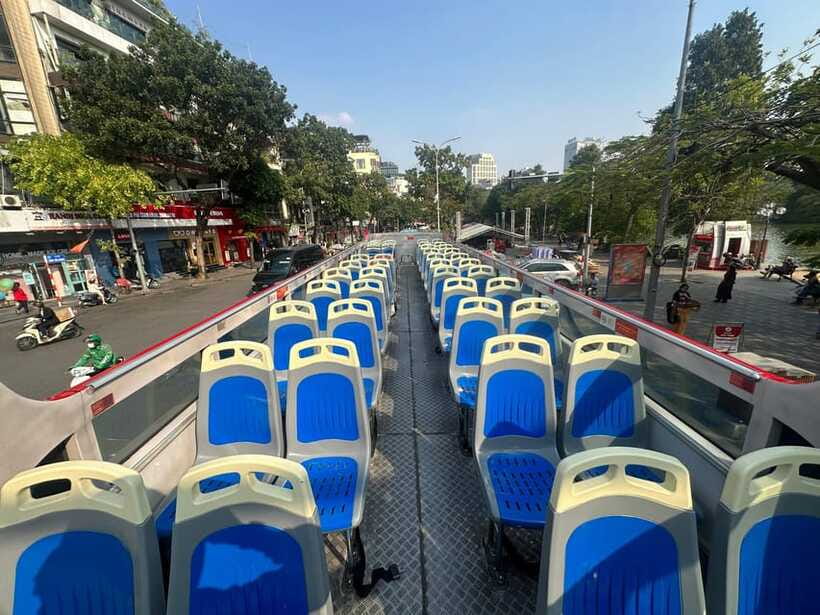
The open-top design is most useful here. From the upper deck, you can look across walls and tree cover and catch rooflines that may be hidden from a low car. On a hot or rainy day, though, the exposed seating can be less comfortable. Free water, a conical hat, and a raincoat are included, which helps, but you should still dress for the weather.
Same base, a completely different day:
- Hanoi Jeep Tour: Food, Culture and Fun by Vietnam Army Jeep
★ 5.0 · 15,222 reviews - Full-Day Ninh Binh Highlights Tour from Hanoi
★ 5.0 · 7,761 reviews - Hanoi: Ha Long Bay Day Cruise – Swimming, Meal, Kayaking
★ 4.7 · 7,415 reviews - Hanoi: Water Puppet Show Tickets
★ 4.6 · 7,029 reviews
The Imperial Citadel and Temple of Literature

The Imperial Citadel of Thang Long is one of the most important historical sites along the route. It represents Hanoi’s long role as a political center and connects the modern capital with earlier royal periods.
Again, this is a drive-by view. You will not receive an entrance ticket, and admission fees are not included. The bus is useful for showing you where the citadel is, especially if you are still learning the city, but you need a separate visit to understand the grounds properly.
The Temple of Literature is another major highlight. It is associated with Confucian learning and Vietnam’s scholarly tradition. The site is known for its courtyards, stone stelae, gates, and quiet garden spaces, all of which contrast sharply with the traffic outside.
I like having the Temple of Literature on a short city route because it gives the ride real historical range. Hoan Kiem shows the city center, Ba Dinh shows modern national identity, and the Temple of Literature points to older educational and cultural traditions.
Hoa Lo Prison and the French quarter
Hoa Lo Prison is one of Hanoi’s most thought-provoking historic sites. Its story spans the French colonial period and the later wartime era, and the surviving sections now form a museum.
You will pass the prison, not enter it. That distinction matters. Hoa Lo requires time and attention, so I would save it for a separate visit if you want more than a quick visual reference.
The route continues toward the Vietnam Women’s Museum and the Hanoi Opera House. The museum focuses on the lives and contributions of Vietnamese women, while the Opera House is one of the city’s most elegant French-influenced buildings.
The bus finishes at the Opera House, which is a practical end point. You can continue on foot toward the lake, the Old Quarter, nearby museums, or the French quarter. Since you cannot get off and reboard during the circuit, finishing here is also a reminder to plan your next stop before you leave the bus.
On Friday from 7:30 pm, and on Saturday and Sunday, the pickup point is at Hanoi Opera House rather than the lake. Check the day and time carefully before setting out. The change is easy to miss if you assume every departure uses the same stop.
What the audio guide adds, and where it falls short

Commentary is available in English, French, German, Spanish, Russian, Japanese, Korean, and Vietnamese. When it works well, the audio helps connect a building to its purpose instead of leaving you to guess at every landmark.
I would bring headphones if the system allows them, but the supplied information does not specify the equipment or connection method. More importantly, do not depend on perfect audio. A German passenger found no audio guide available, and a French passenger reported that the commentary was sometimes out of sync with the places visible from the bus.
There were also reports of crackling and background disturbance. That matters because Hanoi traffic is already noisy, especially on busy streets. If the sound drops out, use the ride as a visual overview and save detailed learning for a museum or a separate visit.
The eight language choices are still a real advantage for an international audience. Just keep expectations reasonable. This is not a live guide who can answer questions or adjust the explanation to your interests.
Price, comfort, and the non-stop rule
The $7 fare is hard to criticize if you use the bus for orientation. You get a one-hour ride, a city map, Wi-Fi, water, a conical hat, a raincoat, and bus insurance. You also avoid paying entrance fees at sights you may not have time to visit.
The value drops if you expect a full sightseeing day. There are no entrance tickets, food, drinks, hotel transfers, or tourism insurance. You also cannot use the ticket as a true hop-on, hop-off pass.
The non-stop rule deserves special attention. You have access once during the pass period. If you get off, you cannot board again. That means you should stay aboard for the complete loop if your aim is to see the whole route.
The bus is wheelchair accessible, but non-folding wheelchairs are not allowed. Mobility scooters, bicycles, baby strollers, and oversize luggage are also prohibited. Smoking, alcohol, chewing gum, and food for animals are not allowed on board.
Who should book this Hanoi bus tour?
I would book this for a first day in Hanoi, a short visit, or a traveler who wants a broad look without arranging several taxis. Families and older visitors may also appreciate the chance to cover ground while seated, though the no-stroller rule matters.
It is less suitable if you want to spend time inside monuments, take photographs at a relaxed pace, or hear a precise explanation of every sight. A walking tour or private guide will give you more depth. This bus gives you range.
The upper deck is likely the best seat for views, but weather and traffic noise can affect comfort. If you want the most pleasant ride, choose a time when the weather is mild and avoid building your entire sightseeing plan around one exact departure.
Should you book it?
Book it if you want a cheap, simple overview of Hanoi and understand that you will stay on the bus. The route covers a useful mix of lakefront streets, Old Quarter lanes, colonial buildings, temples, museums, the Ho Chi Minh Complex, and the Opera House.
Skip it if your main goal is reliable audio, interior visits, or a flexible hop-on, hop-off day. The occasional sound problems and the single-boarding rule make this a basic orientation ride rather than a complete sightseeing solution.
For $7, I see it as a sensible first look. Use the bus to mark the places you want to explore, then return to two or three of them on foot.
FAQ
How long does the Hanoi open-top bus tour last?
The complete loop lasts approximately one hour.
Is this a hop-on, hop-off tour?
No. It is a non-stop bus tour. You can board once during the pass capacity, and if you get off, you cannot get back on.
How much does the tour cost?
The listed price is $7 per person.
Which landmarks does the bus pass?
The route passes Hoan Kiem Lake, Saint Joseph Cathedral, Hanoi Flag Tower, Ho Chi Minh Mausoleum, Quan Thanh Temple, Tran Quoc Pagoda, Cua Bac Church, the Imperial Citadel of Thang Long, the Temple of Literature, Hoa Lo Prison, the Vietnam Women’s Museum, Hanoi Opera House, and Hanoi Post Office, along with more than 20 attractions overall.
What languages are available for the audio guide?
The audio guide is offered in Chinese, English, German, Japanese, Korean, French, Spanish, and Vietnamese. The highlights also list Russian, so check the available options when boarding.
Where is the meeting point?
From Monday through Friday until 7:00 pm, meet at Dong Kinh Nghia Thuc Square, 7 Dinh Tien Hoang, near the red double-decker bus ticket booth. From 7:30 pm Friday, and on Saturday and Sunday, pickup is at Hanoi Opera House.
How often does the bus run?
The scheduled frequency is every 30 minutes.
What are the operating hours?
The bus operates from 8:30 am to 9:30 pm Monday through Thursday, and from 8:30 am to 8:00 pm Friday through Sunday.
Are entrance fees included?
No. Entrance fees, food, drinks, hotel pickup and drop-off, and tourism insurance are not included.
Can I cancel the booking?
Yes. You can cancel up to 24 hours in advance for a full refund. You can also reserve now and pay later, according to the booking terms.
Newly reviewed in Hanoi
- Private Full-Day Tour to Halong Bay from Hanoi★ 5.0 · 44 reviews
- Private Evening Walking Tour – Cyclo & Water Puppet Show in Hanoi Old Quarter★ 5.0 · 19 reviews
- Ba Vi National Park Private Tour: Sightseeings & Jungle Hikking★ 4.5 · 26 reviews
- Full-Day Hanoi City Tour with Hidden Local Life Experience★ 5.0 · 27 reviews
- Hanoi Epic tour 6D5N Hanoi – Halong Bay – Ninh Binh – Sapa★ 5.0 · 51 reviews
- Private transfers Hanoi <=> Puluong 1 Way (Free Hotel Pickup)★ 5.0 · 20 reviews
- Hanoi Airport Pick-up (Private Ride From Hanoi Airport to Hotels)★ 4.5 · 253 reviews
- Noi Bai Airport transfer to Hotel or Vice versa★ 5.0 · 144 reviews
Tours in Hanoi, compared.

Hanoi Jeep Tour: Food, Culture and Fun by Vietnam Army Jeep
Read our review →
Full-Day Ninh Binh Highlights Tour from Hanoi
Read our review →
Ha Long Bay Day Cruise – Swimming, Meal, Kayaking
Read our review →

Hanoi Motorbike Tour: Food, Culture and Fun by Vintage Motorbike
Read our review →

Hanoi Cooking Class: Culture, Local Market & Meaning CSR Impact
Read our review →