
Reviewed · TOURS IN HO CHI MINH CITY
1 Hour Saigon River Tour in Ho Chi Minh
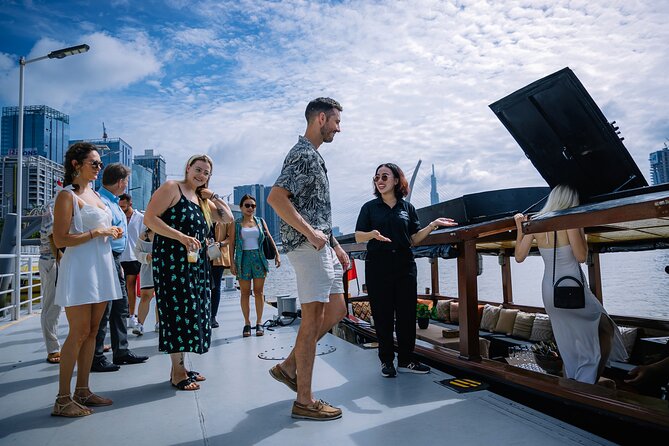
Ho Chi Minh City’s skyline makes more sense from the water. This one-hour Saigon River cruise gives you a quick view of old port buildings, busy waterways, new towers, bridges, and the city’s fast-changing eastern bank without asking you to fight street traffic. I like the small wooden boat, the river breeze, and the chance to see the illuminated skyline after dark. The guide adds useful history, and guides such as Will have earned especially warm praise for their clear, engaging commentary.
I also like the practical design: a sliding roof protects you from strong sun or sudden rain, and there is a restroom on board. The main drawback is the seating. Some passengers face away from the city, and a full boat can make it awkward to turn for photographs. The river itself can also look muddy and industrial rather than postcard-pretty.
Key points to know before boarding
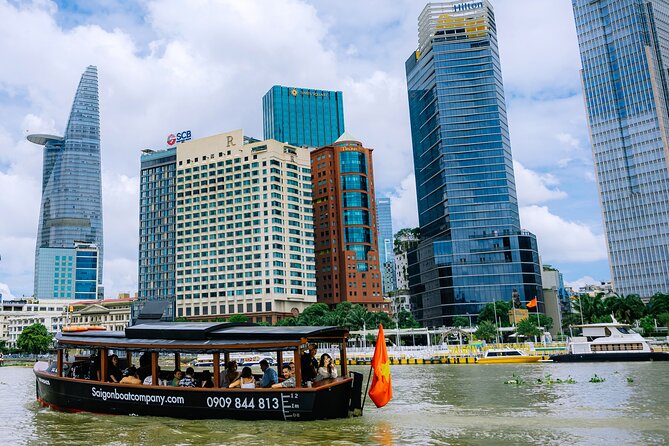
- One hour from Bach Dang Pier: The boat leaves from central District 1 and returns to the same meeting point.
- A compact city overview: You see District 1, District 4, Thu Thiem, major bridges, riverfront buildings, and skyscrapers.
- Best for sunset and city lights: Afternoon and evening departures let you choose between daylight views, sunset, or an illuminated skyline.
- Small-group setting: The maximum is 20 people, with some departures carrying fewer passengers.
- Comfort in mixed weather: The boat has a sliding roof, river breeze, onboard drinks and snacks for purchase, and a restroom.
- Good value at $12.50: It is inexpensive for a guided city outing, but it is an introduction rather than a long scenic cruise.
What this one-hour Saigon River cruise really offers
This is not a full-day sightseeing trip or a quiet voyage into rural Vietnam. It is a short urban cruise designed to fit neatly into a busy Ho Chi Minh City schedule.
For $12.50 per person, you get a captain, an English-speaking guide, and about an hour on the river. That price makes sense if you want a different angle on the city and a break from traffic. You are paying less for a grand boat excursion than for a relaxed moving viewpoint with local context.
I would treat it as a city orientation. From the river, Ho Chi Minh City appears in layers: colonial-era buildings near the old port, commercial towers around District 1, the dense waterfront of District 4, and the wide-open development zone of Thu Thiem. The guide helps connect those pieces.
The experience has received a 4.7 rating from 418 reviews, with 93 percent recommending it. The strongest praise centers on the guides, easy boarding, friendly staff, comfortable small boat, and evening views. The weaker experiences usually come down to crowded seating, hard-to-hear commentary, diesel fumes near the captain, or expectations that the river would be prettier and the landmarks closer.
That balance is important. Book it for the viewpoint and the atmosphere, not because every sight will be a close-up attraction.
More days out you can book in Ho Chi Minh City:
- Cu Chi Tunnels Tour from HCM City – Morning or Afternoon
★ 5.0 · 15,833 reviews - From HCM City: Mekong Delta Tour with Sampan Journey
★ 4.5 · 13,132 reviews - Ho Chi Minh City Street Food Tour & Sightseeing By Motorbike
★ 5.0 · 9,413 reviews
Starting at Bach Dang Pier in District 1
The meeting point is Ga tàu thuỷ Bạch Đằng, or Bach Dang Waterbus Station, at the riverfront in Ben Nghe, District 1. This is a convenient starting point if you are already near the central hotel district, Nguyen Hue Walking Street, or Dong Khoi Street.
Boarding is generally quick, and the boat returns to the same pier at the end. That makes the cruise easy to fit between sightseeing stops, dinner, or an evening walk through central Saigon.
Try to arrive with enough time to look at the seating before settling in. The boat uses long rows along the sides, and some seats face away from the city. If photography matters to you, keep your phone or camera ready and be willing to shift your attention from side to side as the boat turns.
The listed maximum is 20 people. That is still a small group by city-tour standards, though the ride can feel crowded when nearly full. Some departures have carried around 13 or 14 people, a size that gives the boat a more personal feel.
The first look at the central Saigon River
Once underway, the cruise follows the Saigon River along central District 1 and District 4. This opening section is useful because it shows how closely the city’s commercial heart is tied to the water.
You pass modern high-rise towers, riverfront activity, and old buildings that recall Saigon’s role as a port. The contrast is the main attraction. One minute you are looking toward glass towers, and the next you are seeing an older structure connected to shipping, customs, banking, or military administration.
The guide provides stories and basic facts about the landmarks. The quality of the commentary can vary by guide and by the position of your seat. Guides named in the feedback include Will, along with friendly female guides praised for their history knowledge and willingness to answer questions. English is often clear, but one passenger found the commentary difficult to understand, so do not expect a polished lecture on every departure.
The river breeze is welcome in Ho Chi Minh City’s heat. Even when the scenery is not dramatic, being away from motorbikes and sidewalks for an hour can be the point.
Dong Khoi Street and the Majestic Hotel
One of the early sights is the Majestic Hotel at 1 Dong Khoi Street. Built in 1925 in a French Riviera style, the hotel reflects the colonial-era commercial district near the river.
From the boat, you will not get the same close look you would have on foot. Still, the river view helps explain the hotel’s location. Dong Khoi leads inland from the waterfront through one of central Saigon’s most historic and expensive streets.
The cruise also passes the statue of Tran Hung Dao, the royal prince and military commander credited with stopping Mongol invasions in the 13th century. This is the kind of detail that makes the commentary useful. You are not simply looking at a statue. You are getting a quick introduction to a major figure in Vietnamese history.
Same base, a completely different day:
- HCM: Cu Chi Tunnels-Tapioca Small Group Tour Morning or Afternoon
★ 5.0 · 7,485 reviews - Cu Chi Tunnels and Mekong Delta Signature Tour
★ 5.0 · 7,328 reviews - Mekong Delta Guided Tour from Ho Chi Minh City
★ 4.5 · 7,192 reviews - Cu Chi Tunnels & Mekong Delta Tour with VIP Limousine Transfer
★ 5.0 · 7,052 reviews
Nguyen Hue, the flagpole, and old port buildings
Nguyen Hue Boulevard runs from the river toward City Hall. Today it is a broad pedestrian street and one of the city center’s main public spaces. Seeing its river end from the boat gives you a sense of how the central district opens toward the water.
The guide also points out the old flagpole. An early version was built in 1865 as a signal mast for incoming ships, while the current structure dates from 1900. It is a small detail, but it ties the modern city back to the river’s practical role in shipping.
The former customs building is another worthwhile sight. Built in 1867 as a private mansion and converted in 1881, it now serves as the customs department headquarters. Nearby, a building constructed in 1928 for the Banque de l’Indochine houses the Saigon branch of the State Bank of Vietnam.
These buildings are easy to miss from street level, where traffic and shopfronts compete for your attention. From the river, you get a cleaner sense of their position along the old waterfront. The tradeoff is distance. The boat does not stop for long visits, so see this as an introduction and plan a walking tour later if architecture is your main interest.
Bridges, the Ben Nghe Channel, and the city’s working side
The route includes one of Saigon’s old bridges, built by a company once led by Gustave Eiffel. The supplied information does not identify the bridge by name, but its engineering history gives the guide a chance to connect Saigon with the wider French colonial period.
You also pass the Ben Nghe Channel, once an important center of commerce because of its location. This section may not deliver the prettiest photographs. It is more useful for understanding how waterways supported business, transport, and urban growth.
The river is not consistently clean. Muddy water, industrial edges, and working boats are part of the view. I would not choose this cruise if you expect a pristine natural setting. The appeal is the living city, including its less polished edges.
A practical note: one passenger seated close to the captain found the diesel smell overwhelming. That is not a problem everyone experiences, but it is worth avoiding the seats directly behind the captain if you are sensitive to engine fumes.
Thu Thiem Tunnel and the old port museum
The boat passes beneath or near the Thu Thiem Tunnel, the first and only tunnel under the Saigon River. It forms part of an important highway connection between the central city and the eastern side.
This is a good example of the cruise’s wider theme: Ho Chi Minh City is still being reshaped around the river. The waterway is not just a historic backdrop. It remains part of the city’s transport system and urban planning.
Another notable building is one of the oldest in Ho Chi Minh City, dating from 1862. It once served as the original port and is now home to the Ho Chi Minh Museum. Seeing it from the boat adds context to the waterfront, though the view is distant and brief.
District 4 comes into view as well. It is an island between the Saigon River and two canals, and it is known as one of the city’s densest neighborhoods. From the water, you can better understand its shape and its close relationship with the port.
Thu Thiem and the modern eastern skyline
As the boat reaches the Thu Thiem side of the river, the scenery shifts. What was once largely uninhabited swamp is now planned as one of Ho Chi Minh City’s major modern districts, with offices, homes, and large parks.
The contrast with old District 1 is one of the most interesting parts of the trip. You can look back toward established towers while watching a newer urban center take shape across the water.
Bitexco Tower is hard to miss. Completed in 2010, it was once Vietnam’s tallest skyscraper, and its lotus-inspired design reflects Vietnam’s national flower. The city skyline includes several other major towers, including an iconic building housing national and international companies and Vietcombank.
The exact distance and visibility depend on the route, weather, and seating. Some passengers find the sights more impressive at night, when the towers and bridges are lit. In daylight, you get a better sense of construction, river traffic, and the relationship between the districts.
The temple, naval command, and Ba Son Bridge
The route includes a temple on the Saigon River bank, one of the few surviving old buildings in Thu Thiem. Its presence is easy to appreciate from the boat because it contrasts with the surrounding modern development.
You also pass a historic riverfront building used by the Southern Naval Command Office. These older structures add variety to a route otherwise dominated by towers, roads, and bridges.
The Ba Son Bridge is the latest addition among the bridges crossing the Saigon River. It is named after the Ba Son Shipyard, a reminder that shipbuilding and river commerce have long shaped this part of the city.
If you choose an evening departure, the bridge can be a highlight. The boat offers a low angle on the structure, and seeing it illuminated from below gives you a view that is difficult to get from the street.
Landmark views from the water
The route also includes Vietnam’s tallest skyscraper, described as the second-tallest tower in Southeast Asia, and the older bridge that was the only connection between the city center and District 2 until 2008.
These sights help show the speed of Ho Chi Minh City’s growth. You see the older gateway toward the east alongside newer infrastructure built to handle a much larger city.
Still, keep your expectations measured. This is a moving tour, not a series of photo stops. You might get a fine view of a tower for only a minute before the boat changes angle. If you want a particular building, sit where you can turn easily and avoid storing your camera deep in a bag.
Afternoon light or evening skyline?
The cruise offers several afternoon and evening departures. Each has a different character.
An afternoon ride gives you more light for identifying buildings, bridges, and river traffic. It is the better choice if you want to follow the guide’s descriptions and see the older structures clearly.
A late departure may offer sunset, followed by the first city lights. This is a strong compromise if the schedule works.
At night, the skyline becomes the main event. The towers glow, bridges become graphic shapes, and the river provides a dark foreground. Several highly praised trips were evening cruises, especially when the boat passed beneath an illuminated bridge.
The roof can slide closed against sun or rain, but the experience still depends on weather. If poor weather cancels the cruise, you can choose another date or receive a full refund. You can cancel for a full refund up to 24 hours before the start time. Changes or cancellations inside that window are not refunded.
Comfort, drinks, and onboard practicalities
The boat is described as a luxury ride, but I would think of it as a comfortable small sightseeing boat rather than a formal luxury cruise. It has a captain, an English-speaking guide, a restroom, and a roof that can open or close.
Drinks and snacks are available for purchase. The selection includes beverages such as draft beer, with prices described as reasonable. Food and drinks are not included in the $12.50 ticket, so plan to pay separately if you want something during the ride.
The small boat creates a friendly atmosphere and makes it easier to hear the guide when the group is not full. On a crowded departure, the same layout can limit movement and block views. If you need a completely open panorama from every seat, this may not be the right boat trip.
Service animals are allowed, the pier is near public transportation, and most people can take part. The activity is limited to a maximum of 20 people.
Who should book this cruise?
I would recommend it to you if you have only a short time in Ho Chi Minh City, want a break from traffic, or would like to see the central skyline after dark. It also works well on a first day, when you want a quick sense of the city’s districts and riverfront before exploring on foot.
It suits couples, solo visitors, families, and small groups who value an easy hour outdoors. The guide makes it more useful than simply hiring a boat for a ride, and the low price makes it a sensible addition to a central Saigon itinerary.
I would be cautious if you are mainly interested in detailed architecture, close-up monuments, or untouched scenery. The commentary can be hard to hear from some seats, the route moves quickly, and parts of the river look industrial. If you are sensitive to diesel fumes, avoid sitting near the captain.
Should you book the one-hour Saigon River tour?
Yes, if you see it as a short guided introduction to Ho Chi Minh City from the water. At $12.50, it offers good value, especially for an evening ride with skyline lights, bridge views, and a cooling river breeze.
Choose a seat with a clear angle toward the city, arrive ready to shift sides for photographs, and consider an afternoon, sunset, or evening departure based on what you want to see. Skip it if you expect a long scenic journey or a spotless river. For most visitors with an hour to spare in central Saigon, this is an easy, affordable way to add another layer to the city.
FAQ
How long is the Saigon River tour?
The cruise lasts approximately one hour.
Where does the tour start?
It starts at Ga tàu thuỷ Bạch Đằng, Bach Dang Pier, in Ben Nghe, District 1, Ho Chi Minh City.
Where does the boat tour end?
The cruise returns to the same meeting point at Bach Dang Pier.
How much does the tour cost?
The listed price is $12.50 per person.
Is an English-speaking guide included?
Yes. An in-person English-speaking guide is included, along with the captain.
Are food and drinks included?
No. Drinks and snacks are available to purchase on board, but they are not included in the ticket price.
Does the boat have protection from sun or rain?
Yes. The boat has a sliding roof that can provide cover from sun or rain.
Is there a restroom on board?
Yes. A restroom is available on the boat.
What is the cancellation policy?
You can cancel at least 24 hours before the start time for a full refund. Cancellations or changes made less than 24 hours before the experience are not refunded. If poor weather cancels the cruise, you can receive a full refund or choose another date.
Newly reviewed in Ho Chi Minh City
- Saigon Evening: Water Puppet Show & Dinner Cruise Experience★ 5.0 · 38 reviews
- Dinner Cruise on Saigon River with Private Table★ 4.5 · 31 reviews
- Ho Chi Minh: Private City Tour and Dinner Cruise with Buffet★ 4.6 · 97 reviews
- Saigon Jeep Tour with Food, Culture and Fun By Vietnam Army Jeep★ 5.0 · 150 reviews
- Cu Chi Tunnels Ben Duoc VIP Tour by Limousine with Lunch★ 5.0 · 170 reviews
- Mekong Delta VIP Tour – Transportation by Limousine★ 5.0 · 110 reviews
- Decadent Vietnamese “Egg Coffee” Workshop in Hồ Chí Minh City★ 5.0 · 150 reviews
- Saigon After Dark Vespa Street Food Tour + Live Music 4 hours★ 5.0 · 147 reviews
Tours in Ho Chi Minh City, compared.

Cu Chi Tunnels Tour from HCM City – Morning or Afternoon
Read our review →
Ho Chi Minh City Street Food Tour & Sightseeing By Motorbike
Read our review →
Cu Chi Tunnels-Tapioca Small Group Tour Morning or Afternoon
Read our review →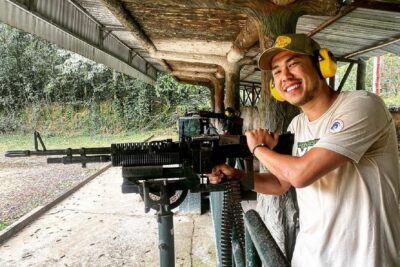
Cu Chi Tunnels and Mekong Delta Signature Tour
Read our review →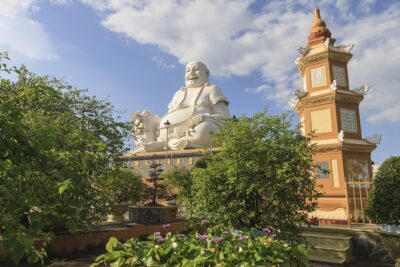
Mekong Delta Guided Tour from Ho Chi Minh City
Read our review →
Cu Chi Tunnels and Mekong Delta Full Day Tour – Max 12
Read our review →
Saigon By Night and Street Food By Motorbike | Opt: Ao Dai Riders
Read our review →Browse the lists this tour appears in