
Reviewed · TOURS IN HANOI
Hanoi Knife Making Traditional Workshop
Da Sy village has forged metal for several hundred years, and this hands-on knife class lets you take part in the work rather than simply watch a demonstration. You sketch a blade, heat steel, swing a hammer, shape the handle, and finish with a practical knife to take home.
I like two things right away: the family-run setting feels personal, and guides such as Tee, Nathan, Khoi, and Minh help turn a language gap into an easy conversation. You also get hotel pickup, equipment, water, and the finished product for $50. The main consideration is that the class suits beginners best. You will do real work, but the master handles some of the more dangerous or technical steps.
Key points to know before you book
- Forge a knife in historic Da Sy village: See how a long-standing Hanoi craft still supports local work today.
- Choose your own design: Pick from available styles or bring a photo to guide the shape.
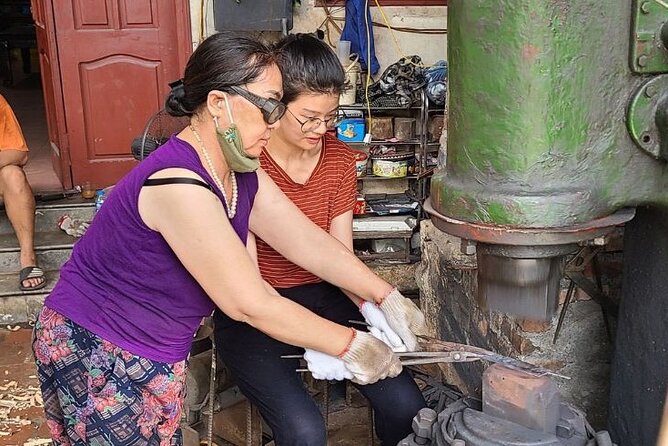
- Take part in nearly every step: Cut, heat, hammer, grind, shape, and finish your knife with close supervision.
- Meet a skilled family of makers: The English-speaking guide translates while the local artisans teach through demonstration and patient coaching.
- Hotel pickup is included: The experience lasts about three hours, with transport from your Hanoi hotel included.
- Expect a beginner-friendly class: You get plenty of hands-on time, but a hydraulic machine and other risky stages remain with the professionals.
A real workshop, not a staged craft display
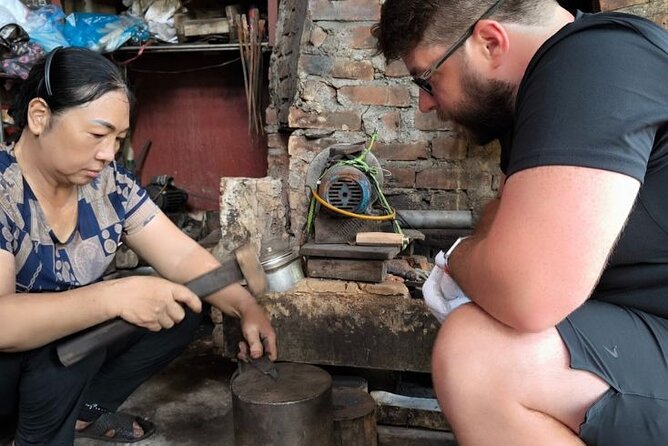
The best part of this experience is the setting. Da Sy is a traditional forging village on the outskirts of Hanoi, known for metalwork that once included weapons and now focuses largely on agricultural tools and household knives.
That background gives the class more weight than a standard souvenir-making session. You are not just shaping a generic object in a tourist studio. You are working alongside a family whose craft has been passed through generations, using the same broad methods that have kept the village’s trade alive.
The workshop is practical and busy. Expect heat, metal dust, grinding noise, and the firm rhythm of hammer on steel. You should come ready to work with your hands, not dressed for a polished museum visit.
More things you make yourself in Hanoi:
- Hanoi Cooking Class: Culture, Local Market & Meaning CSR Impact
★ 5.0 · 5,147 reviews - 5 Traditional Dishes Hanoi Cooking Class with Market Trip
★ 5.0 · 4,890 reviews - Hanoi Coffee Workshop: Taste Salt, Coconut and Egg Coffee
★ 5.0 · 1,286 reviews
Pickup from Hanoi and the ride to Da Sy
Hotel pickup is included, and you are asked to wait about five minutes in the lobby. The ride matters because Da Sy is outside Hanoi’s central tourist area. You avoid arranging your own transport, and an English-speaking guide can explain what you are seeing along the way.
Guides have included Tee, Nathan, Khoi, and Minh. Their roles go beyond translation. They explain the village’s forging background, help you understand instructions, and keep the session moving between the local artisans and English-speaking visitors.
Nathan has also introduced people to Vietnamese fruit, tea, and candy during the ride or workshop visit. Khoi has been praised for looking after the group from hotel pickup through the return journey. Tee is especially useful when you need a careful explanation of the blade-making steps or want help choosing a design.
The exact guide depends on the booking, so do not reserve this expecting one particular person. What you can count on is an English-speaking guide and a small-group option.
Choosing a blade before the fire starts
The class begins with the design. You can select a knife from several models, and some sessions allow you to work from a photo of a shape you want to copy. A few people have chosen a hybrid design, combining features from a village style with a Japanese-style kiritsuke blade.
This choice is more important than it sounds. A kitchen knife, farming blade, or compact utility knife will have a different shape and balance. Ask the guide what is practical for the time available before you settle on an elaborate design.
You then sketch the blade onto a piece of durable metal. The drawing establishes the outline of the cutting edge and the tang, the section that extends into the handle. This is the first point where the knife begins to feel like your own rather than a factory item.
If you have little drawing or metalworking experience, do not worry. The class is aimed at beginners, and the local makers will guide you through the proportions.
Heating, cutting, and hammering the steel
The first physical stage involves cutting out the rough blade and tang. You work with basic blacksmithing tools such as a hammer, cutter, and anvil, then place the metal into glowing embers.
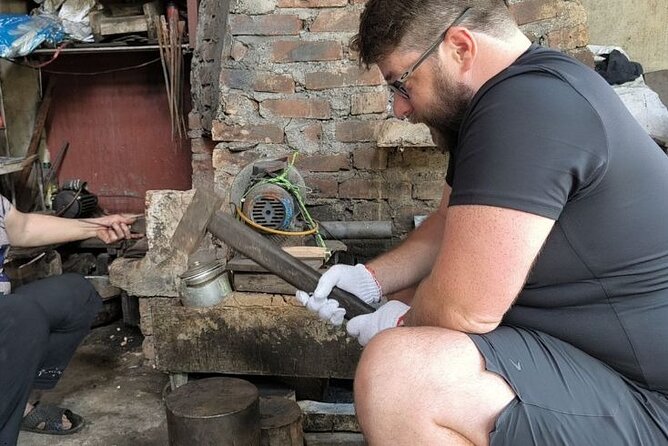
With the steel hot, you take turns striking it with the maker. This is the most memorable part for many people because you feel the material change under the hammer. The master shows the movement first, then helps you adjust your grip, stance, and timing.
You will not be left alone beside the fire. That is important for safety, but it also means the class is not a full professional apprenticeship. Some participants want to carry out every possible task, while others prefer to hammer a few times and let the expert manage the rest.
The right expectation is guided participation. You are involved in the process, but the artisan protects the quality of the final knife and keeps you away from the riskiest operations.
Same base, a completely different day:
- Hanoi Jeep Tour: Food, Culture and Fun by Vietnam Army Jeep
★ 5.0 · 15,222 reviews - Full-Day Ninh Binh Highlights Tour from Hanoi
★ 5.0 · 7,761 reviews - Hanoi: Ha Long Bay Day Cruise – Swimming, Meal, Kayaking
★ 4.7 · 7,415 reviews - Hanoi: Water Puppet Show Tickets
★ 4.6 · 7,029 reviews
Where the artisans take over
After the rough forging, the blade may need trimming and correction. A hydraulic cutting machine handles one of the more dangerous stages. You may watch this work, but you should not expect to operate the machine yourself.
That division of labor is sensible. A handmade souvenir is only worthwhile if it is safe and usable. The master’s job is to correct uneven edges, refine the shape, and make sure your finished knife looks like a functioning tool rather than a bent piece of steel.
Some people with substantial do-it-yourself experience may find the amount of professional intervention limiting. You will hammer the heated metal, but you are not being trained to perform every industrial or blacksmithing technique independently. For a first workshop, though, this balance lets you work directly with the material without turning the class into a hazardous test.
Grinding, tempering, and the secret finishing wash
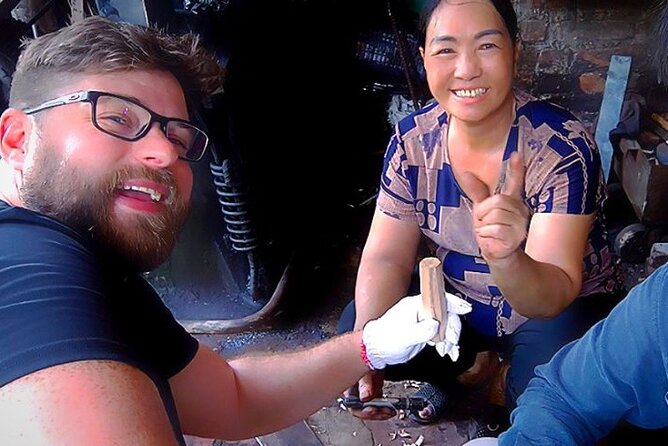
Once the blade has its rough shape, it goes to the grindstone. You take part in sharpening and polishing while the maker checks the angle and edge.
The process includes several stages, including a tar-based chemical wash made from a family recipe. The artisans use this as part of the treatment and finishing work. It is one of the small details that shows how much of the technique remains local and closely guarded.
The finished edge can be extremely sharp. One session produced two very sharp kitchen knives, and another ended with a blade described as razor sharp. That makes the final handling lesson important. Follow the guide’s instructions, use the provided gloves, and do not treat the new knife like a harmless souvenir.
You also have the chance to shape or carve the wooden handle. This is a satisfying stage because it affects how the knife sits in your hand. Some people have been able to make a handle that fits their grip, adding a personal touch beyond the blade shape.
Meeting the family behind the forge
The people make this experience work. The local artisans do not necessarily speak English, so your guide translates their instructions and questions. That arrangement also lets you see how teaching happens through demonstration: the maker shows a movement, watches your hands, and corrects you as you work.
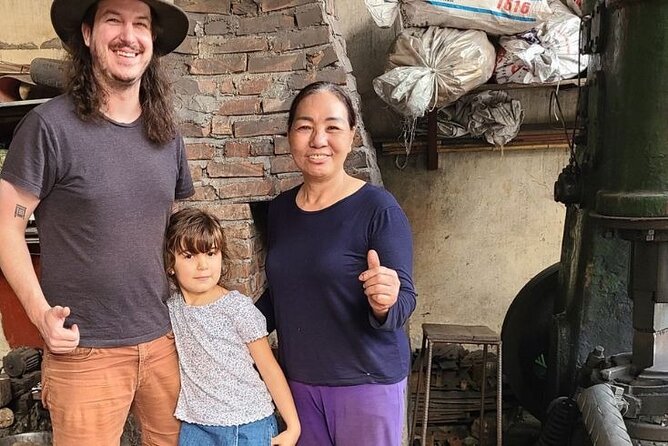
Mrs. Tuyen, also known as Do Thi Tuyen, has taught visitors with decades of experience. One session described her as having 40 years in the craft. Other classes have included Trung, who helped visitors work toward a sharp finished edge.
The tone is informal and welcoming. Tea, snacks, and small tastes of Vietnamese fruit or candy may be part of the visit, depending on the session. Some groups have stayed to talk with the family and look around the shop after the knife was complete.
That contact is one of the strongest reasons to choose this class. You are seeing how a local household makes its living, and the finished knife carries a clearer connection to the place than a shop-bought souvenir.
How much of the knife do you really make?
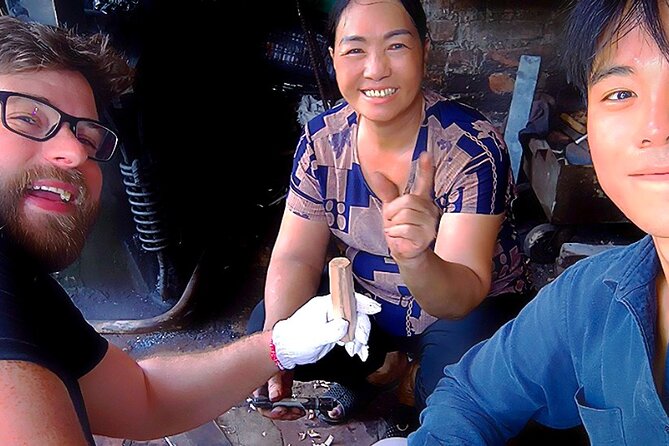
The answer is: a good amount, but not every technical stage. You can expect to help with the design, rough cutting, heating, hammering, grinding, and handle work. The exact amount of control depends on your confidence, the group size, and the artisan’s judgment.
The experience is flexible. You can ask to do more yourself, or allow the master to handle most of the work while you assist. One particularly useful approach is to tell the guide at the start how hands-on you want to be.
I would choose the middle ground. Take part in the safe, visible stages, then let the expert manage the machinery and final corrections. That gives you a real sense of the labor without risking an injury or ending with a knife that needs to be rebuilt.
The class is best for true beginners, curious cooks, families with older children, and anyone who likes making practical objects. It may disappoint an experienced blacksmith looking for independent instruction or a long technical course.
What the $50 price includes
At $50 per person, the price is strong because it covers more than the class itself. You get:
- Hotel pickup and return transport
- About three hours of instruction
- An English-speaking guide
- A local master and workshop equipment
- One 500-milliliter bottle of water
- The knife you make
The value comes from combining transport, translation, materials, and a finished object. A typical craft activity may give you a small decorative item. Here, you leave with a useful knife made to your selected style.
The price can increase by $10 during New Year and Tet, Liberation Day or Reunification Day on April 30, International Workers’ Day on May 1, and National Day on September 2. Check the final holiday price before booking.
The experience offers free cancellation up to 24 hours before the start time, and you can reserve now and pay later. Starting times depend on availability, so check the schedule before planning the rest of your day.
Practical clothing and safety advice
Wear comfortable shoes. You will be standing, moving around the workshop, and working near hot metal and grinding equipment.
Use the gloves provided or recommended by the workshop, especially during hammering and handling the blade. The finished knife is sharp, and the work area includes fire, cutting tools, and machinery. Keep alcohol and drugs out of the experience, as required by the operator.
This is not suitable for people over 95 years old. The supplied details do not give a separate accessibility assessment, so contact the provider if you have mobility or medical concerns.
Small groups are available, and a smaller class should give you more direct time with the master. Private sessions have also taken place. If doing the work yourself is the main reason you are booking, a small group or private format is worth requesting.
Who will enjoy this most
I would recommend the class to you if you want a souvenir with a story and do not mind getting warm, dusty, and involved. It is a good fit for solo visitors, couples, small groups, and families with teens. Even people without craft experience can follow the basic stages with help.
It also suits anyone interested in Vietnamese village industries. The class connects your finished knife to Da Sy’s forging tradition, rather than treating the village as a quick photo stop.
You may want to skip it if you dislike heat, loud workshop noise, or hands-on work. It is also not the right choice if you expect to learn every professional technique and operate every machine. The artisans remain responsible for the most dangerous steps, and they may reshape or finish the blade for you.
Should you book the Da Sy knife class?
Book it if you want a personal, useful souvenir and a look at local work outside central Hanoi. The strongest parts are the patient family of makers, the English-speaking guides, the option to choose your design, and the chance to take part from hot steel to finished handle.
Go in with sensible expectations. You are not becoming a trained blacksmith in three hours, but you are doing far more than watching a demonstration. At $50, with pickup, equipment, guidance, and the completed knife included, this is a good-value Hanoi activity for hands-on beginners.
FAQ
Where does the knife-making class take place?
The class takes place in Da Sy village, on the outskirts of Hanoi. The listed location is Dong Bac, Vietnam.
How long does the activity last?
The stated duration is three hours. Check availability for the exact starting time.
Is hotel pickup included?
Yes. Pickup from your hotel is included. You should wait about five minutes in the hotel lobby.
Is the guide fluent in English?
The activity includes an English-speaking live guide. Guides such as Tee, Nathan, Khoi, and Minh have helped translate between visitors and the local knife makers.
What will I make during the class?
You will make a simple knife. The process can include choosing a design, sketching the blade, cutting and heating the steel, hammering, grinding, sharpening, and shaping the handle.
Can I choose the knife design?
Yes. You can choose from available knife styles, and some sessions allow you to use a photo of a preferred design.
Do I get to keep the knife?
Yes. The product is included, so you take home the knife made during the class.
Is equipment provided?
Yes. Workshop equipment and instruction from the master are included.
What should I wear or bring?
Bring comfortable shoes. Follow the workshop’s safety guidance and use gloves when working with the knife and hot metal.
Can I cancel for a refund?
You can cancel up to 24 hours in advance for a full refund. The reserve-now, pay-later option is also available.
Newly reviewed in Hanoi
- Private Full-Day Tour to Halong Bay from Hanoi★ 5.0 · 44 reviews
- Private Evening Walking Tour – Cyclo & Water Puppet Show in Hanoi Old Quarter★ 5.0 · 19 reviews
- Ba Vi National Park Private Tour: Sightseeings & Jungle Hikking★ 4.5 · 26 reviews
- Full-Day Hanoi City Tour with Hidden Local Life Experience★ 5.0 · 27 reviews
- Hanoi Epic tour 6D5N Hanoi – Halong Bay – Ninh Binh – Sapa★ 5.0 · 51 reviews
- Private transfers Hanoi <=> Puluong 1 Way (Free Hotel Pickup)★ 5.0 · 20 reviews
- Hanoi Airport Pick-up (Private Ride From Hanoi Airport to Hotels)★ 4.5 · 253 reviews
- Noi Bai Airport transfer to Hotel or Vice versa★ 5.0 · 144 reviews
Tours in Hanoi, compared.

Hanoi Jeep Tour: Food, Culture and Fun by Vietnam Army Jeep
Read our review →
Full-Day Ninh Binh Highlights Tour from Hanoi
Read our review →
Ha Long Bay Day Cruise – Swimming, Meal, Kayaking
Read our review →

Hanoi Motorbike Tour: Food, Culture and Fun by Vintage Motorbike
Read our review →

Hanoi Cooking Class: Culture, Local Market & Meaning CSR Impact
Read our review →
5 Traditional Dishes Hanoi Cooking Class with Market Trip
Read our review →Browse the lists this tour appears in