
Reviewed · TOURS IN HANOI
Hanoi Knife Making Traditional Workshop
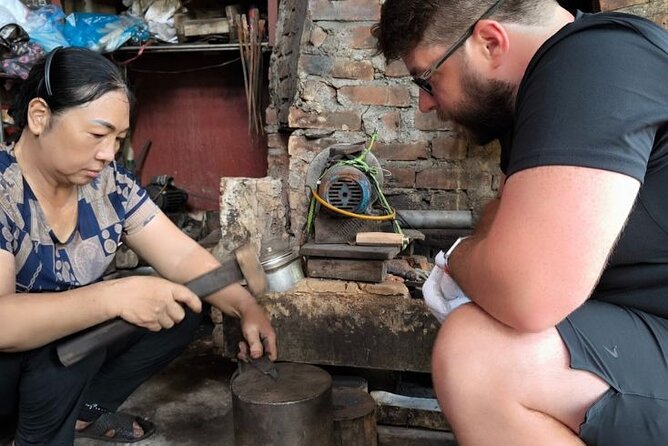
The hot work begins fast: you sketch a blade, cut metal, heat it in glowing coals, and take turns hammering it on an anvil. This is not a polished museum visit. It is a working family workshop where forging has been passed down for generations.
I like the hands-on process, especially the chance to shape a real blade instead of simply watching a demonstration. I also like the small group limit of 10, plus the patient guidance offered by local makers and English-speaking guides such as Nathan.
The main drawback is simple: this is hot, physical work around metal, hammers, grinding equipment, and chemical treatment. You need moderate fitness, and anyone hoping for a relaxed sightseeing stop may find the class demanding.
Key points to know before booking
- You make the knife from raw metal: The class covers design, cutting, forging, shaping, and sharpening.
- The workshop sits in a traditional forging village outside Hanoi: The village has made tools for several hundred years and once supplied weapons during wartime.
- You work beside local family members: Their experience comes from generations of forging, and the teaching is described as patient and practical.
- Nathan may guide your trip: He is noted for being engaging and attentive during the journey to and from the workshop.
- The experience lasts about 3 hours and 30 minutes: Air-conditioned transport and iron material are included, but lunch and tips are not.
- The group stays small: A maximum of 10 people makes it easier to get help at the anvil and grinding station.
A working forge outside Hanoi
This experience takes you beyond central Hanoi to a craft village known for metal forging. The village has practiced the trade for several hundred years. Its work changed with the times, moving from wartime weapons to agricultural tools and household implements.
That background matters because you are not learning knife making in a staged studio built only for visitors. You are visiting a place where forging remains part of local work. The class gives you a direct look at a trade that has supported families across generations.
The transfer from Hanoi is part of the outing. Pickup is offered, and the included vehicle is air-conditioned, a useful comfort in Vietnam’s heat. The details supplied for the experience do not give a precise pickup time or list of pickup areas, so confirm those points before you pay.
The total outing lasts about three and a half hours. That is long enough to work through the basic stages without turning the activity into a full-day commitment. You should still allow extra time around the stated duration if Hanoi traffic affects the drive.
More things you make yourself in Hanoi:
- Hanoi Cooking Class: Culture, Local Market & Meaning CSR Impact
★ 5.0 · 5,147 reviews - 5 Traditional Dishes Hanoi Cooking Class with Market Trip
★ 5.0 · 4,890 reviews - Hanoi Coffee Workshop: Taste Salt, Coconut and Egg Coffee
★ 5.0 · 1,286 reviews
Meeting the family behind the craft
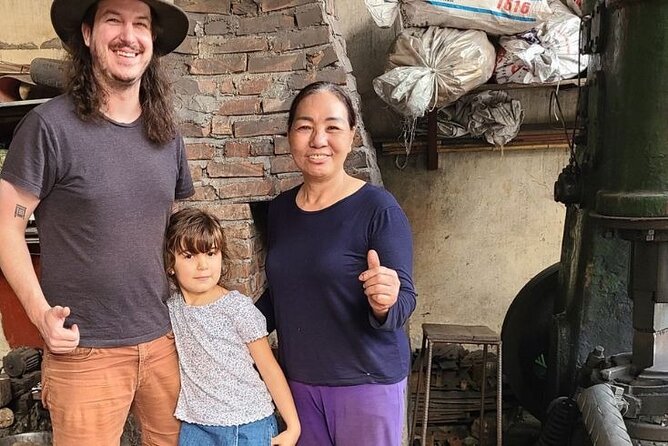
At the workshop, you meet local makers and see the family setting where the class takes place. One family member explained that people in the trade can begin learning as young as 12. That detail helps explain the speed and control you will see from the makers, even when the process looks rough and forceful.
Your role is not to match their skill. You are there to learn the main movements under guidance. The makers help you through each phase, correcting the work and handling parts of the process that require more experience.
The small group size is a real advantage here. With no more than 10 people, the class should feel more personal than a large demonstration. You will have a better chance to ask questions, speak with the family, and receive help when your blade needs adjustment.
An English-speaking guide is included. Nathan is specifically noted as a patient and engaging guide who helps make the journey pleasant as well as organized. Guide assignments can change, so treat Nathan as an example rather than a guarantee for every departure.
Sketching a blade you can actually use
The first stage is design. You sketch the shape of your blade on a sheet of metal chosen for durability. This sounds modest, but it gives the finished knife a personal touch and makes you think about the object before the hot work begins.
You also decide the basic size. One person who took the class chose the size of the knife, and the supplied details indicate that participants can select from different options. The exact range is not specified, so ask at the workshop if the size or shape choices matter to you.
The blade includes the tang, the narrow section that extends into the handle. At this point, you are laying out both parts rather than drawing only the cutting edge. That makes the first step more useful than a simple souvenir decoration.
Do not expect a precision design course. The goal is to create a simple knife while learning the traditional sequence. Small irregularities are part of the process, and the makers trim them later with a hydraulic cutting machine.
Hammering beside the anvil
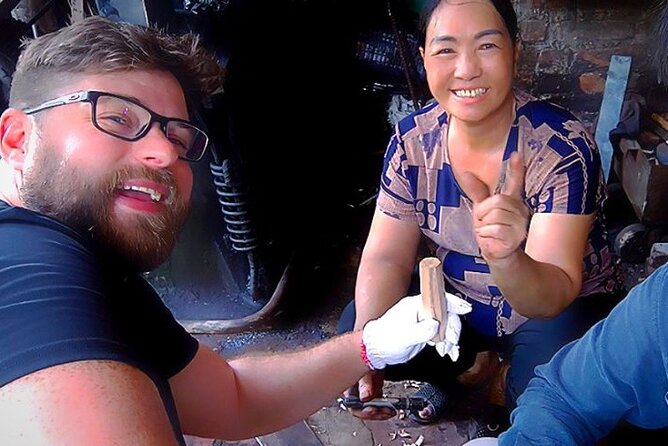
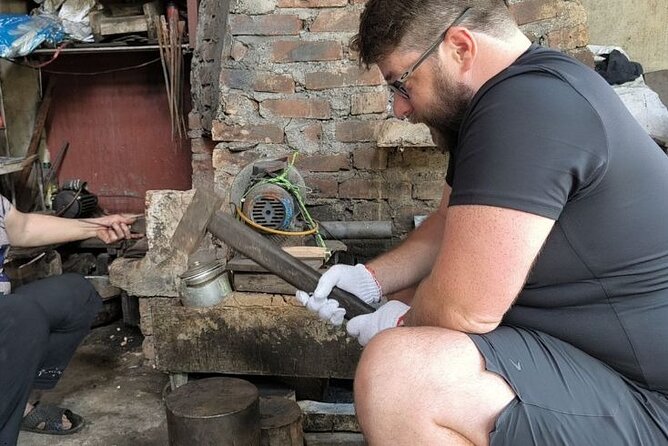
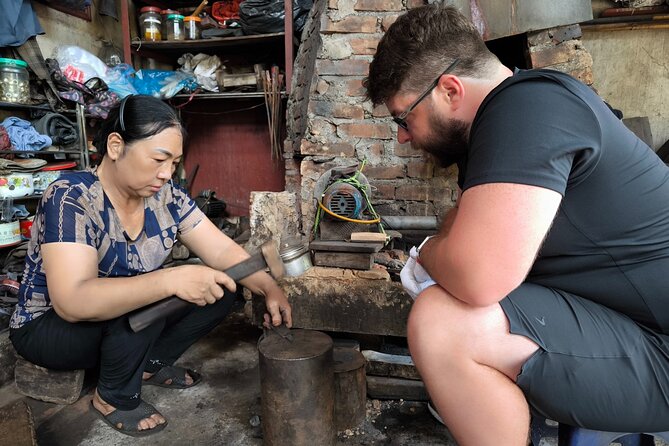
After the design comes the loudest and most physical stage. You use a hammer and cutter to separate the blade and tang from the metal, then place the piece into crackling embers.
Once the metal heats, you alternate blows with the maker to shape the blade. This shared rhythm is the heart of the class. The local smith brings years of timing and judgment, while you supply some of the effort and learn how the metal responds.
You should expect heat, noise, and repeated movement. The experience calls for a moderate level of physical fitness, and that advice should be taken seriously. Hammering and standing at a forge are not passive activities.
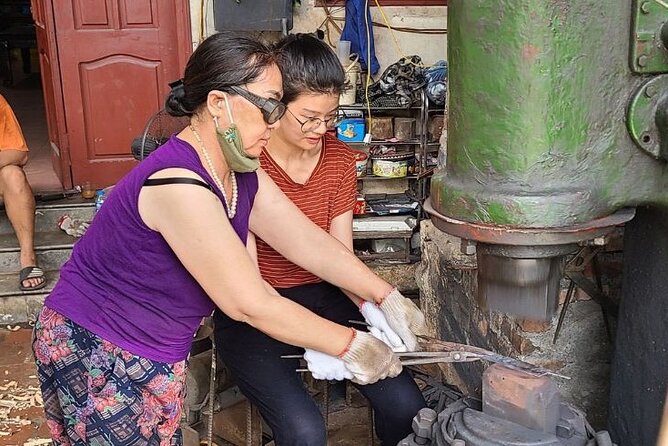
At the same time, the class is not asking you to work alone. The family members guide the process and help fix imperfections. The makers handle the technical parts that need greater control, including trimming with hydraulic equipment when needed.
This is where the small group becomes most useful. A large class could leave you waiting or watching from the side. With a maximum of 10 people, you have a better chance to take part directly and receive help at the right moment.
Same base, a completely different day:
- Hanoi Jeep Tour: Food, Culture and Fun by Vietnam Army Jeep
★ 5.0 · 15,222 reviews - Full-Day Ninh Binh Highlights Tour from Hanoi
★ 5.0 · 7,761 reviews - Hanoi: Ha Long Bay Day Cruise – Swimming, Meal, Kayaking
★ 4.7 · 7,415 reviews - Hanoi: Water Puppet Show Tickets
★ 4.6 · 7,029 reviews
Shaping, trimming, and making the blade straight
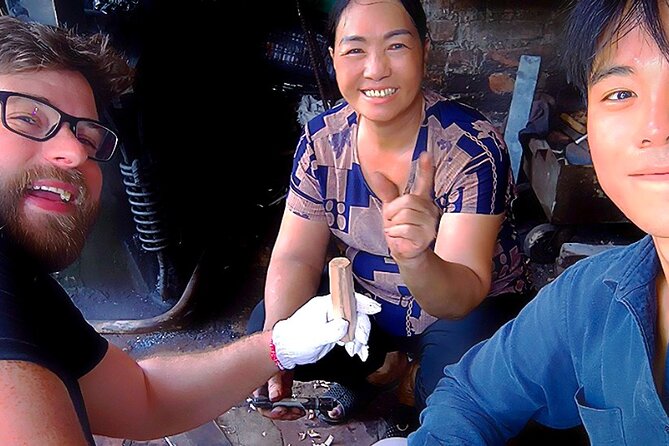
Forging gives the metal its rough knife form, but the work is not finished when the hammering stops. The next stage refines the shape. The makers inspect the piece, then use a hydraulic cutting machine to remove imperfections that cannot be corrected by hand.
That combination of old and modern tools is one of the interesting parts of the visit. The hammer, anvil, and embers connect you to the traditional method. The hydraulic cutter adds speed and control where hand work alone would be less practical.
You may find that your blade looks less even than the maker’s work at first. That is normal for a short class. The point is to take part in the sequence and understand how a plain piece of metal becomes a usable tool.
The activity is best suited to someone who enjoys making things and does not need a perfect, factory-finished result. If you want a flawless professional knife, buying one may be the better choice. If you want to understand the labor behind a Vietnamese kitchen tool, the rough edges make the lesson more memorable.
Grinding and the family’s secret wash
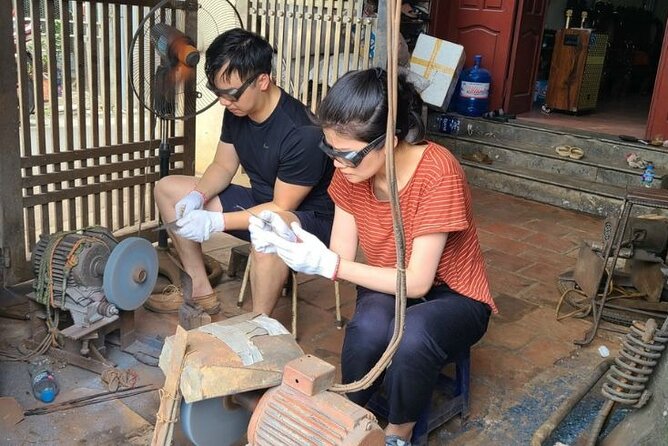
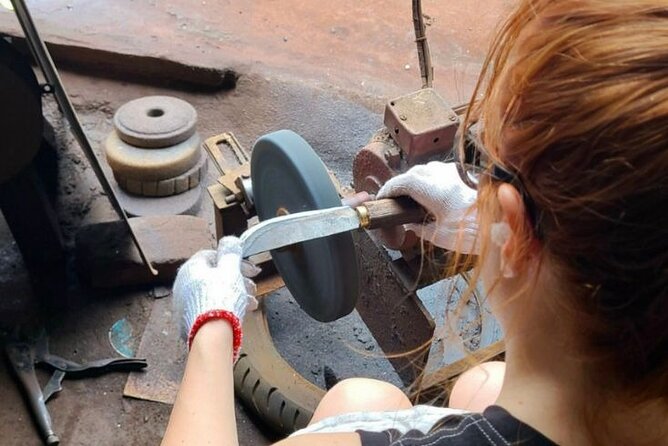
Sharpening is the final major stage. The blade goes onto a grindstone, where its edge is shaped through several phases. You will see that sharpening is not a single quick pass. It requires care, repeated adjustment, and attention to the angle of the edge.
One phase includes soaking the blade in a tar-based chemical wash made from a secret family recipe. The supplied details do not identify the ingredients or explain the exact treatment, so you should follow the maker’s instructions closely during this part.
This unusual step adds a glimpse into the family’s own method. Not every detail is presented as a standard industrial formula. Some knowledge remains tied to the workshop and passed through the family.
The knife you make is intended to go home with you. That gives the activity a practical ending: you leave with an object connected to the work you just performed, rather than only photographs or a certificate. The exact finish and final quality can vary because you are making the blade by hand under instruction.
What the $50 price covers
At $50 per person, the cost is reasonable if you value participation rather than simple transport to a sightseeing stop. The price includes an air-conditioned vehicle, iron material, and an English-speaking guide. It also covers access to a family workshop and instruction through the main stages of knife making.
The strongest value comes from the amount of activity packed into three and a half hours. You sketch, cut, forge, shape, and sharpen. You also meet local makers and see a traditional trade in its working setting.
Lunch is not included, and tips are not included. Since the experience is not a full-day trip, the lack of lunch is not a major problem, but you should plan your meal separately. The information provided does not specify food stops or a meal break.
Group discounts are available. That may make the class more attractive for friends or families who want to try something unusual together. The group limit remains 10 people, so larger parties should confirm how the booking will be arranged.
The price makes most sense for people who would normally pay for a craft workshop, guided transport, and a locally made object separately. It is less appealing if your main goal is an inexpensive ride to a village or a quick demonstration.
Who will enjoy this class most
I would choose this for someone who wants a story attached to a souvenir. A handmade knife carries more meaning when you have drawn the blade, stood beside the forge, and helped shape the metal.
It also suits curious food lovers, craft enthusiasts, and people who have already seen Hanoi’s temples and markets and want a different side of the city. The class shows how a useful object is made and gives you time to talk with people whose families have worked in the trade for generations.
The activity may suit older children or teenagers only if they can follow instructions and meet the moderate fitness requirement, but the supplied information does not give a minimum age. Confirm age rules before booking for a child.
You should think twice if you dislike heat, loud tools, standing, or hands-on work. This is not a soft cultural stop where you watch from a shaded seat. The setting is a real forge, and the work has some physical strain.
The experience is also a good fit for small groups. Friends can compare their blade shapes and share the work, while solo participants can benefit from the limited group size and direct help from the makers.
Practical points for a smoother visit
Wear clothing you can work in and be ready for a hot, active session. The provided information does not give a specific clothing list, so follow any instructions from the operator after booking.
Confirm your pickup details, since transport is offered but the exact collection arrangements are not stated. The air-conditioned vehicle should make the trip more comfortable, especially in hot weather.
Keep the full 3-hour, 30-minute window free. Hanoi traffic can affect a short outing, and the stated duration is approximate. If you have a flight, train, or timed attraction afterward, leave a generous gap.
The activity requires good weather. If poor weather forces a cancellation, you can receive a different date or a full refund. It also requires a minimum number of bookings, so a cancellation for that reason brings the same choice of another date or experience, or a full refund.
Free cancellation is available up to 24 hours before the start time. Cancel at least 24 hours ahead for a full refund. Changes or cancellations within 24 hours are not accepted and are not refunded.
Should you book the Hanoi knife-making workshop?
Book it if you want an unusual Hanoi experience built around making something with your hands. The strongest reasons are the family workshop, the clear step-by-step process, the chance to speak with local makers, and the useful knife you take home.
I would not book it for a quiet half-day outing or a polished culinary class. The work is hot and physical, and your finished blade may show the marks of a beginner. That is also the point: you get a direct lesson in the patience and skill behind a common tool.
At $50, the class offers good value for someone who wants transport, instruction, materials, and a personal souvenir in one outing. Nathan has been a notably patient guide, and the small group limit should help keep the session active rather than crowded.
For a craft-focused visit with real local contact, this is an easy choice. Just arrive ready to work, confirm pickup details, and leave enough time around the three-and-a-half-hour schedule.
FAQ
Where does the knife-making experience take place?
It takes place in a traditional forging village on the outskirts of Hanoi. The village has practiced forging for several hundred years.
How long does the experience last?
The activity lasts approximately 3 hours and 30 minutes.
What is included in the price?
The price includes an air-conditioned vehicle, iron material for the knife, and an English-speaking tour guide.
Is pickup from Hanoi offered?
Yes, pickup is offered. The exact pickup details are not specified, so confirm the arrangements after booking.
How many people can join the class?
The maximum group size is 10 people.
Do I make the entire knife myself?
You take part in the main stages, including design, cutting, forging, shaping, and sharpening. The local maker guides you and handles parts of the work that require greater experience.
Can I take the finished knife home?
Yes. The experience is designed to let you take home the knife you make.
Is lunch included?
No. Lunch is not included in the price.
Do I need to be physically fit?
You should have a moderate level of physical fitness. The class includes hammering, standing, working near a forge, and using a grindstone.
What is the cancellation policy?
You can cancel at least 24 hours before the start time for a full refund. Cancellations or changes made less than 24 hours before the start time are not accepted and are not refunded. If poor weather or a failure to reach the minimum number of bookings cancels the activity, you are offered another date or experience, or a full refund.
Newly reviewed in Hanoi
- Private Full-Day Tour to Halong Bay from Hanoi★ 5.0 · 44 reviews
- Private Evening Walking Tour – Cyclo & Water Puppet Show in Hanoi Old Quarter★ 5.0 · 19 reviews
- Ba Vi National Park Private Tour: Sightseeings & Jungle Hikking★ 4.5 · 26 reviews
- Full-Day Hanoi City Tour with Hidden Local Life Experience★ 5.0 · 27 reviews
- Hanoi Epic tour 6D5N Hanoi – Halong Bay – Ninh Binh – Sapa★ 5.0 · 51 reviews
- Private transfers Hanoi <=> Puluong 1 Way (Free Hotel Pickup)★ 5.0 · 20 reviews
- Hanoi Airport Pick-up (Private Ride From Hanoi Airport to Hotels)★ 4.5 · 253 reviews
- Noi Bai Airport transfer to Hotel or Vice versa★ 5.0 · 144 reviews
Tours in Hanoi, compared.

Hanoi Jeep Tour: Food, Culture and Fun by Vietnam Army Jeep
Read our review →
Full-Day Ninh Binh Highlights Tour from Hanoi
Read our review →
Ha Long Bay Day Cruise – Swimming, Meal, Kayaking
Read our review →

Hanoi Motorbike Tour: Food, Culture and Fun by Vintage Motorbike
Read our review →

Hanoi Cooking Class: Culture, Local Market & Meaning CSR Impact
Read our review →
5 Traditional Dishes Hanoi Cooking Class with Market Trip
Read our review →Browse the lists this tour appears in